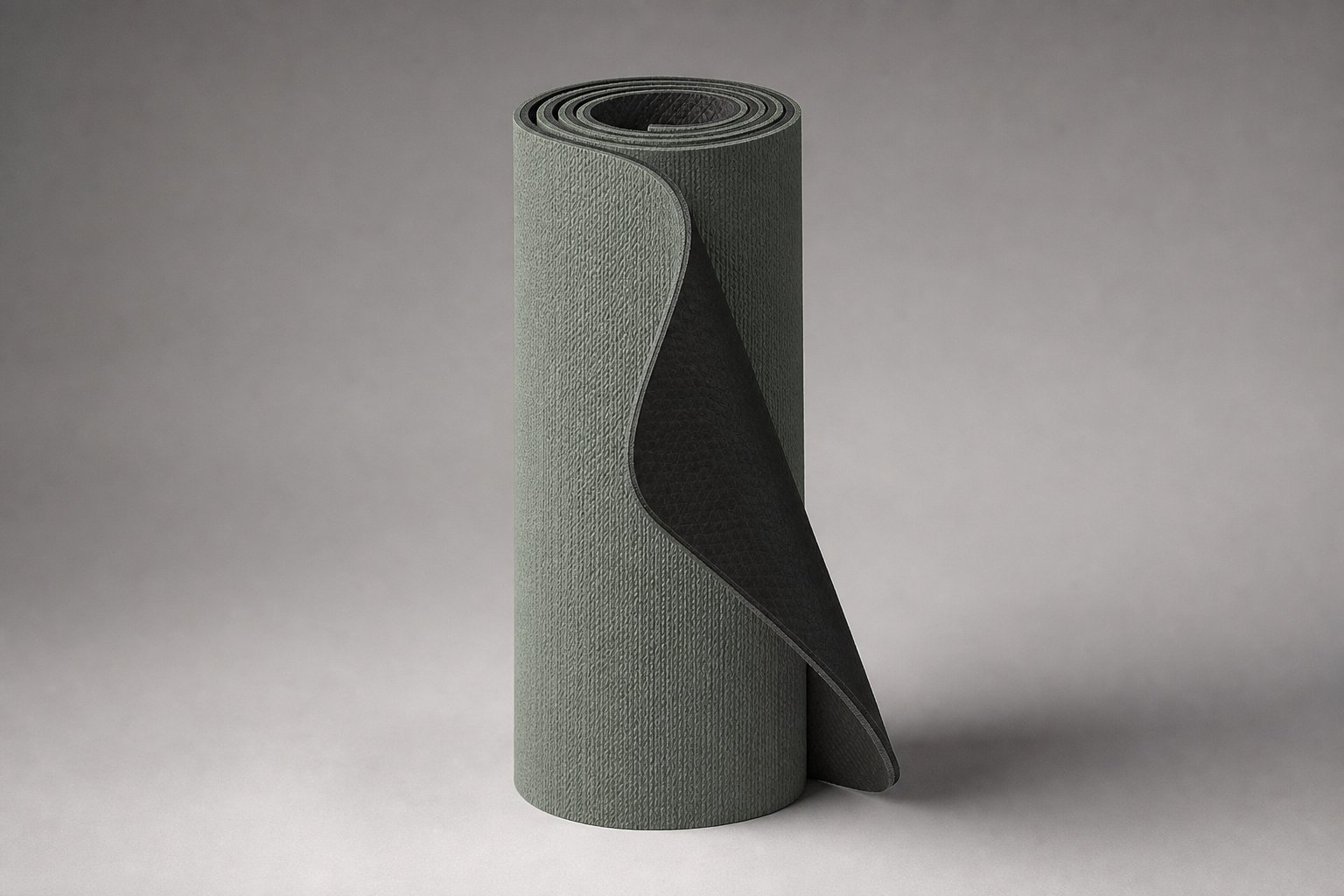
Yoga mats are the classic red-ocean category: commodity TPE mats list at USD 3.9-4.8 with MOQ 10 on the platforms, the category grows at a modest 3.6 percent a year (Grand View Research, 2024-2030), and a listing built on price alone joins a race no importer wins. The escape route runs through the one attribute a screenshot cannot copy: the material, and the compliance documentation behind it. Our yoga and pilates line is built on three materials — TPE, NBR and natural rubber in 6-10 mm thicknesses — and we treat material transparency as the product: phthalate and PAHs test reports travel with the goods, because material compliance is precisely what separates a defensible mat listing from another price war contestant. This article compares the three materials across grip, cushioning, weight, odor and cost, explains what the compliance story actually requires, and closes with the bundling logic that turns the category's red ocean into a margin pool.
The category reality: a slow-growing red ocean
Straight talk first. The global yoga mat market grows at about 3.6 percent a year on Grand View Research's 2024-2030 outlook — steady, not spectacular — while the entry price floor sits at rock-bottom commodity levels. Meanwhile the adjacent discipline is moving faster: Market Research Future projects pilates equipment and gear growing from USD 5.35 billion in 2024 to USD 11.07 billion by 2035 (CAGR 6.83 percent; single-source, medium-low confidence, cited with those caveats). The commercial translation: a standalone cheap mat is a subscription to price wars, but a mat program tied to material quality, compliance documents and pilates-adjacent sets — rings, blocks, straps — rides the faster current. That is the strategic frame for everything below: material choice is not a spec decision, it is a positioning decision.
TPE: the volume default
Thermoplastic elastomer (TPE) is the modern mainstream mat material: a closed-cell foam, usually in two layers of different densities, that is light to carry, kind to floors, easy to wipe clean and largely free of the latex-allergen question. Closed-cell structure means sweat and water stay near the surface — hygienic and quick-drying, though grip drops when genuinely wet, which is why pairing TPE mats with a yoga towel in listings is honest merchandising. TPE accepts color beautifully and die-cuts cleanly for alignment lines, and its mid-price position supports real packaging design. The trade-offs: grip under heavy sweat is mediocre, edge durability over years is moderate, and because TPE dominates the market, undifferentiated TPE listings are exactly where the price war is fought. Our guidance: TPE is your volume SKU, but it must carry a differentiator — alignment lines, a color system, or the compliance documentation we discuss below — never a bare-bones listing.
NBR: budget comfort with a grip cost
Nitrile-butadiene rubber foam (NBR) is the thick, squishy, budget-friendly mat most beginners meet first. Its virtues are cushioning and price: at thicknesses toward 10 mm it flatters knees and spine in floor work, which makes it a sensible home, stretching and rehabilitation-adjacent choice, and its cost tier supports aggressive bundle pricing. The costs are honest but must be listed: the open, airy foam compresses deeply and is less stable in balance poses; grip is weaker than rubber; the material is heavier per mat than TPE at equal thickness; and durability under daily studio use is limited — NBR is a home-frequency product. Position NBR honestly as the comfort entry, not as a studio mat, and the returns stay predictable. In a catalog, NBR serves the value tier where the buyer's first question is price and the usage is gentle.
Natural rubber: the premium gripper
Natural rubber is the mat that serious practitioners and studios gravitate to, and the physics is the reason: open-cell rubber grips best precisely when hands are damp, which is the exact moment closed-cell foams fail. It is denser and heavier than foam mats, it costs more per unit, it carries a characteristic rubber odor that fades with airing, and it requires the latex-allergen disclosure that responsible listings carry. What it buys is authenticity: a natural rubber mat with a documented material story is the defensible premium product this category otherwise lacks, and it anchors studio and teacher channels where mats are used daily by critical users. Our line specifies natural rubber at 6-10 mm within the category thickness band; pair it with cork blocks in photography and bundles and the premium positioning sells itself.
| Attribute | TPE | NBR | Natural rubber |
|---|---|---|---|
| Grip (dry) | Good | Moderate | Excellent |
| Grip (sweaty) | Moderate — pair with towel | Moderate-weak | Excellent — open cell shines |
| Cushioning at thickness | Good, stable | Soft, deep compression | Dense, responsive |
| Weight | Light | Heavier at equal thickness | Densest |
| Cell structure | Closed-cell, wipes clean | Open airy foam | Open-cell |
| Odor / allergen notes | Low odor; latex-free | Low odor; latex-free | Characteristic odor, fades; latex-allergen disclosure |
| Relative price tier | Mid | Low | High |
| Channel fit | Volume home, corporate gifting sets | Value home, gentle use, rehab-adjacent | Studios, teachers, premium retail |
Compliance is the product feature nobody can screenshot
Here is the differentiation most sellers waste. Foam and rubber products sit squarely inside chemical compliance regimes: the EU's REACH Annex XVII restricts phthalates (the 0.1-percent-by-weight class of restrictions) and polycyclic aromatic hydrocarbons (PAHs) in products with prolonged skin contact — exactly what a yoga mat is. Our material discipline: test reports for phthalates and PAHs are arranged at sampling, refreshed per material batch, and ship with the goods so your listing can make a documented claim instead of a whispered one. In a category where the visible product is identical, the paperwork is the product: a mat listing that shows a phthalate report converts the safety-conscious buyer — parents, studios, physio-adjacent channels — that a commodity listing never touches. Compliance details for the EU market are summarized on our quality page, and the yoga-specific testing angle is unpacked further in our phthalates article.
Bundling: the exit from the price war
The last move is structural. A mat alone is a price comparison; a set is a decision. Mat plus EVA or cork blocks plus a strap is the beginner kit that converts category entry into a basket; mat plus pilates ring rides the fastest-growing adjacent discipline (with the MRFR caveat above); mat plus carrying sling plus towel is the studio-commuter set. Because all the components ship light, sets stay inside the golden parcel band where reviews accumulate quickly and freight never eats the margin — the reason our yoga line is organized as bundles from the start rather than as orphan SKUs. Within sets, the material hierarchy gives you price architecture: NBR as the value set, TPE as the core set, natural rubber as the premium anchor with the compliance story in the gallery.
Conclusion
Choose materials by channel, not by fashion: TPE as the differentiated volume default, NBR as the honest comfort entry, natural rubber as the premium grip anchor for studios and teachers — and put the phthalate and PAHs documentation behind every claim, because in this category the report is the moat. Bundle into sets, ride the pilates current, and stop competing where the screenshot already decided the winner. Send us your market and price band, and we will return a material and set recommendation with indicative quotes and the compliance document list we ship with the goods.
Frequently asked questions
Which yoga mat material should a new store lead with? TPE, differentiated — alignment lines, a color system or documented compliance — as the volume core; add NBR as a value tier and natural rubber as the premium anchor. Leading with undifferentiated TPE at the floor price enters the price war with no exit.
Is natural rubber worth the premium? For studios, teachers and sweaty practitioners, yes: open-cell rubber grips best exactly when hands are damp, and durability under daily use is strong. It is heavier and pricier and requires latex-allergen disclosure in the listing.
What compliance documents should ship with yoga mats? Phthalate and PAHs test reports aligned to EU REACH Annex XVII requirements (the 0.1 percent restriction class) for prolonged skin contact, refreshed per material batch. The documentation is the differentiator in a category where visible products look identical.
How can sellers avoid the yoga mat price war? Sell sets, not orphan SKUs: mat plus blocks plus strap, or mat plus pilates ring for the faster-growing adjacent discipline. Sets ship light, lift AOV, and move the buying decision away from single-SKU price comparison.