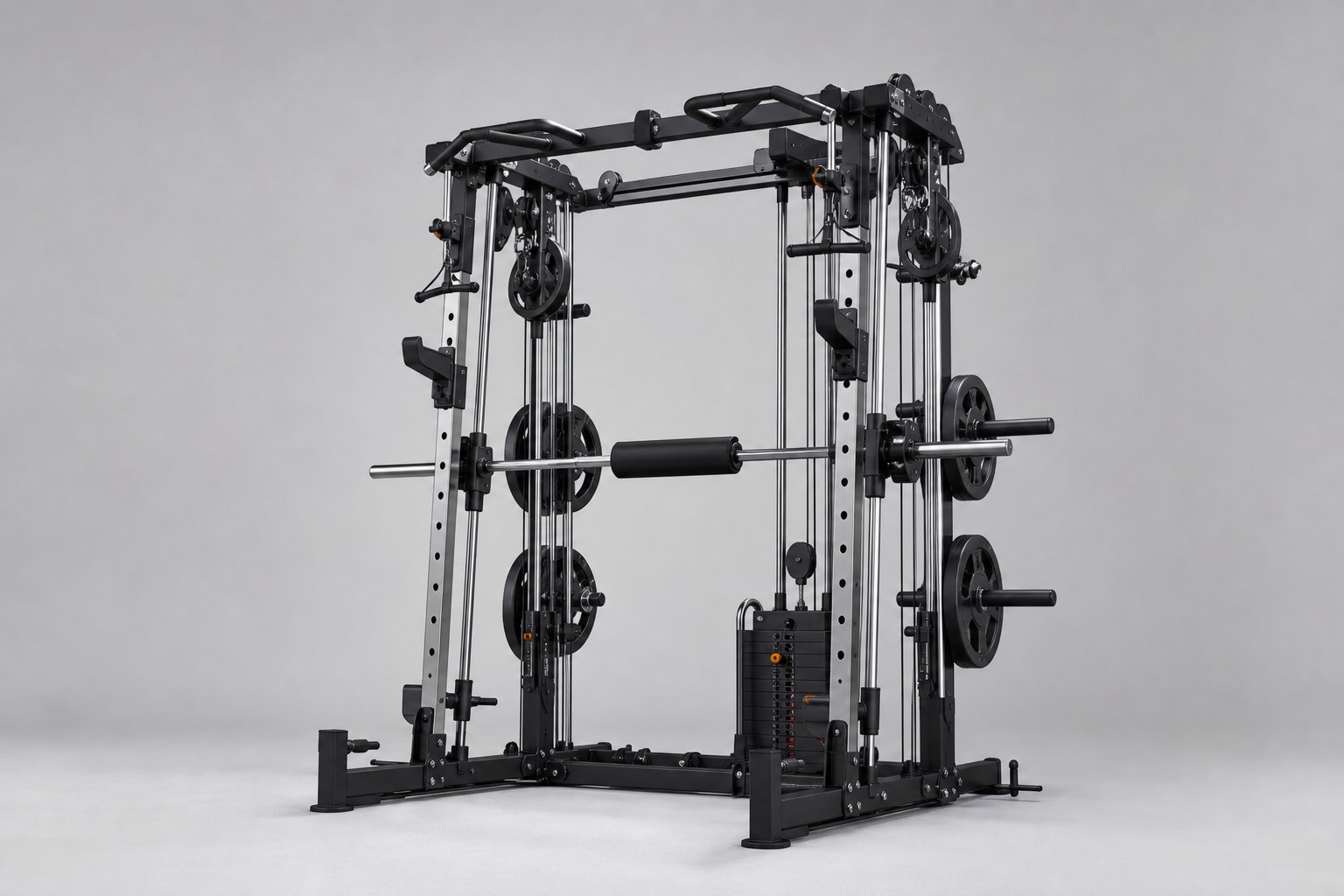
Every strength catalog eventually faces the same stocking question: smith machine or power rack? They look like competitors and are often compared as if one were better, but they are different products selling to different buyers — a guided bar riding on bearing sliders versus a free bar on hooks and safeties. Stock the wrong one for your channel and it shows up as slow sell-through, mismatched expectations in reviews, or a customer who returns for the other machine within a year. This comparison stays at the level that matters for a reseller: how each machine works, who actually buys each one, how they differ on safety, footprint and freight, and how to position both if you carry them side by side. The goal is not to crown a winner — it is to match the machine to the customer so precisely that the comparison sells itself.
How each machine actually works
The mechanical difference is one line long and explains everything downstream. A smith machine runs its bar on a fixed vertical or slightly angled path, riding on carriage bearings along the upright rails; the bar can rotate on its sleeve and hook onto the rail at any height, which is what allows a solo user to bail by twisting the wrist. A power rack holds a free barbell on J-hooks, with safety arms or pins set below the working height; the bar moves wherever the lifter moves it. Fixed path means the machine balances the weight for the user — front-to-back and side-to-side stability come from the rails. Free path means the lifter balances the weight, which is harder but is precisely the skill and stimulus strength buyers are purchasing. Neither is better in the abstract; each one optimizes for a different definition of progress.
Training outcomes: guidance versus carryover
For the end user, the smith machine trades stabilization for accessibility. Beginners can load a realistic weight on day one because the rails catch errors; coached environments use it for controlled tempo work and for movements where balance would otherwise limit load; and its fixed path isolates prime movers efficiently. The rack is the opposite trade: every set also trains the stabilizing musculature and the bar path itself, so strength gained transfers directly to free-barbell lifting — the reason powerlifting and general-strength buyers default to racks. For a reseller the translation is simple: the smith machine sells on safety and ease, the rack sells on performance and expandability. Write listings to those motivations and the two products stop competing for the same click.
Buyer profiles: who actually buys which
Channel data from our category experience is consistent. Smith machines skew toward buyers whose end users are beginners or supervised: personal-training studios that want clients under load with minimal spotting, hotel and corporate gyms where unsupervised guests self-serve, and rehab-adjacent facilities that value the fixed path for controlled range-of-motion work. Power racks skew toward buyers whose end users train for strength without supervision: the garage-gym segment that pairs a rack with a bar and plates, performance-minded home users, and small-group strength studios. There is a hybrid worth naming: combo units that mount a smith carriage on one side and free J-hooks on the other, popular where one machine must serve mixed users in tight spaces. The combo carries the freight weight of a smith with the versatility pitch of a rack — a reasonable middle SKU for stores serving both profiles in one market.
| Dimension | Smith machine | Power rack | Reseller note |
|---|---|---|---|
| Bar path | Fixed on carriage bearings | Free, set by lifter | Guidance versus carryover is the core pitch |
| Stabilizer demand | Low; rails balance the load | High; lifter balances the load | Explains buyer-type fit in one sentence |
| Solo safety | Rotate-and-hook bail at any height | Safety arms or pins at set height | Safety sells to unsupervised environments |
| Attachments | Integration-led: pulleys, multi-grip bar | Ecosystem-led: hooks, arms, landmine | Rack attachments drive repeat purchases |
| Upright steel | 50×120×3.0 mm commercial / 50×100×2.5 mm home | Same discipline | One steel standard across both lines |
| Usage class | Class S or H per EN ISO 20957-2 | Class S or H per EN ISO 20957-2 | State the class; it is the first B2B question |
| Freight profile | Heavier, integrated frame, more crate volume | Modular, flatter pack | Plan mixed containers around the smith |
| Best fit | Studios, hotels, PT and rehab-adjacent | Garage gyms, performance buyers | Match machine to end-user profile |
Space, freight and the container reality
The two machines also differ in how they travel, and that difference should shape your stocking math. A rack breaks down into tubes and brackets: flat-ish cartons, hardware in labeled packs, and a floor footprint in the container that mixes well with lighter goods. A smith machine carries its rails, carriage and often an integral frame in one heavy assembly — more crate volume, more handling care, and a justified claim on container space. The practical consequence: when a mixed order includes a smith machine, plan the container around it and fill the residual volume with rack stock, benches and free weights. Home-line smith units are the exception that ships like furniture, but the commercial line is container-planning territory, and understating its freight personality is how sellers end up paying LCL premiums they did not quote.
Positioning both without cannibalizing either
If you carry both lines, give each a different sentence in your marketing, not the same one. The smith machine's listing should lead with confidence under load: guided path, any-height bail, beginners welcome — aimed at studios, hotels and new trainees. The rack's listing should lead with ownership: free-barbell strength, the attachment ecosystem, a frame that grows with the lifter — aimed at garage and performance buyers. Price them accordingly, bundle differently — a smith pairs naturally with an adjustable bench and guided-programming content, while a rack pairs with hooks, arms, bar and plates — and the two machines will pull in different buyers instead of splitting the same one. Where a market truly cannot support both SKUs, read the channel: unsupervised and hospitality environments buy smith machines; everything that calls itself strength training buys racks.
Conclusion
Smith machine versus power rack is not a verdict; it is a matching exercise. Fixed path or free bar, guidance or carryover, supervised or solo — each machine wins its own buyer completely. Confirm the steel and the usage class, plan freight around the integrated frame, and write each listing to its buyer's actual motivation. Do that and you will not need to choose: the two products will segment your market for you. Send us your channel and end-user profile, and we will recommend the line — smith, rack or combo — with spec sheets and indicative container math attached.
Frequently asked questions
Is a smith machine safer than a power rack for beginners? For solo beginners, usually yes: the guided path plus any-height rotate-and-hook bail removes most failure modes. A rack is also safe solo when safety arms are set correctly, but it expects the user to manage the free bar.
Does smith machine training build less strength than free-barbell work? It builds strength with less stabilization demand, so carryover to free-barbell lifting is smaller. Buyers training specifically for barbell performance should default to a rack; buyers prioritizing accessibility are well served by a smith.
Are combo smith and rack units worth stocking? For mixed-user, space-constrained channels — studios, hotels, apartments — yes. A combo carries smith-like freight weight with rack-like versatility, and it often becomes the compromise SKU that serves both buyer profiles.
Which one should I import first? Read the end user. Unsupervised, hospitality or beginner-led environments point to a smith machine; strength-focused garage and performance buyers point to a rack. If the channel serves both, start with the rack — its attachment ecosystem generates repeat orders the smith cannot.