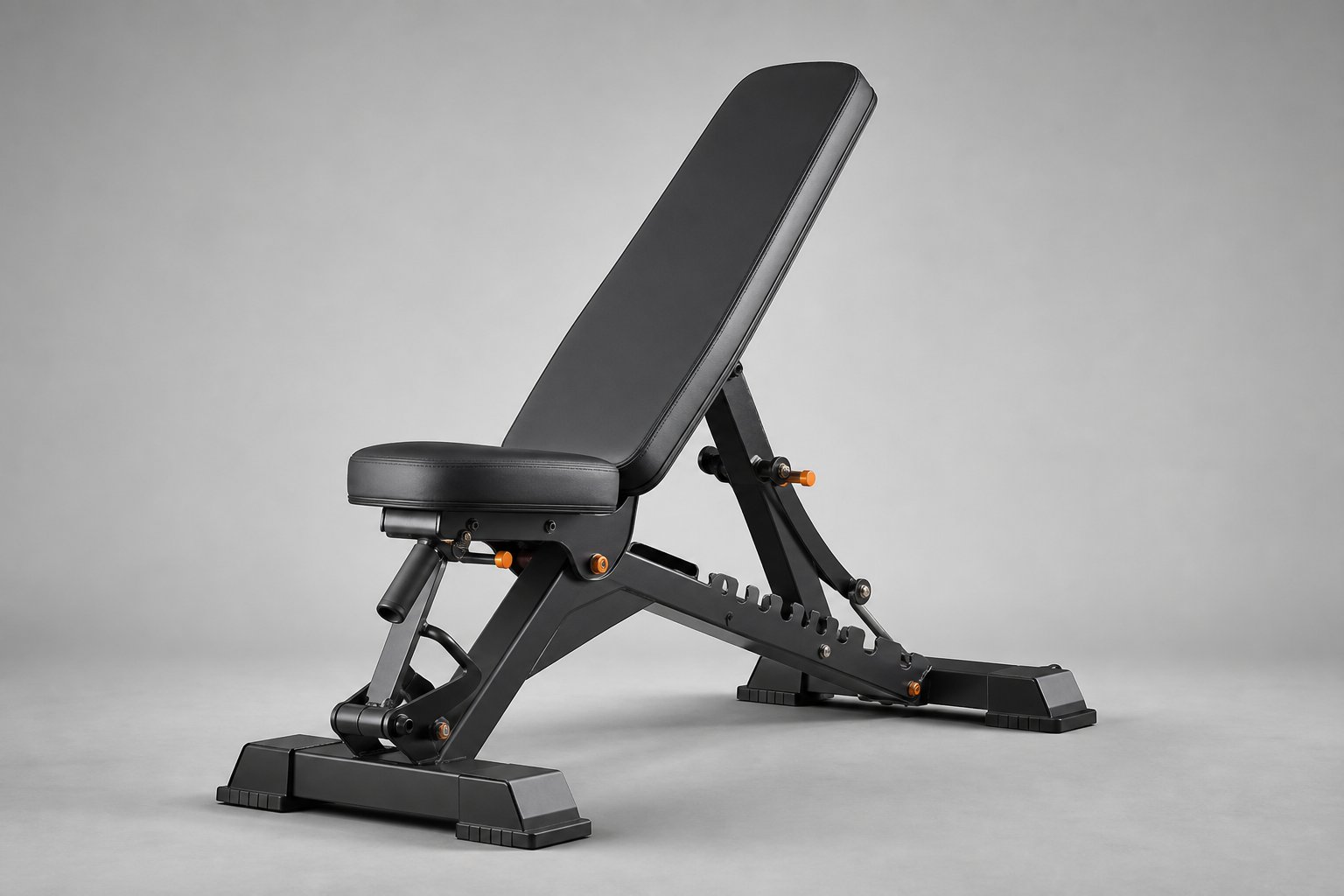
After the rack and the barbell, the bench is the purchase that completes a strength setup — and it is the piece buyers judge with their back. That is why bench complaints cluster around three failures: a frame that rocks under load, a pad that separates or bottoms out, and a ladder that slips at the angle they paid for. All three are predictable from specifications that any supplier can state in writing, and all three are preventable before a container is booked. This guide covers the decisions that matter when stocking benches: flat versus adjustable, the frame and its load-rating basis, the pad, and the backrest ladder — with the EN ISO 20957-4 usage classes that let you match hardware to placement honestly. Publish these parameters on your listings and the bench stops being a return generator and starts being the easiest upsell in your strength category.
Flat or adjustable: stock for the buyer, not the spec sheet
The two bench types serve different buyers and different logistics profiles. A flat bench is the budget-conscious purchase: fewer parts, lighter freight, one job done well, and the natural pairing with a rack for buyers who will press from one position. An adjustable bench covers flat, incline and decline angles on one footprint, which is why it dominates home-gym and studio orders — buyers with limited space want one bench that does everything. Our line carries a seven-position backrest, which spans the angles home and light-commercial users actually program, from flat presses to seated shoulder work. For a catalog decision, a workable split is: adjustable benches as the default listing for home and studio channels, flat benches for budget bundles and commercial side-stations where multiple flat units sit along a dumbbell wall.
The frame: steel, hinges and the load-rating basis
Bench frames fail at their joints, not their tubes. The tubes matter — our strength line uses the same steel discipline as the racks, with heavier sections and wall thickness on the commercial line — but the hinges, pivot pins and welds decide whether the frame stays silent after a year. When you compare suppliers, ask for the load rating and its basis together. Our benches carry a 350 kg rating under a declared test condition (indicative; the declaration sheet states the basis), which covers user weight plus pressed load with margin. A rating without a basis — static? dynamic? user-plus-weight or total? — is marketing. Usage class completes the picture: EN ISO 20957-4 is the part of the standard framework specific to strength benches, and it separates Class S (professional and commercial placements) from Class H (home use). Sell the class with the rating; it is the fastest way to show a serious buyer that the number was not invented for the listing.
The pad: where comfort complaints and returns are born
The pad is the only part of the bench the buyer's body touches, and it is where cheap products earn one-star reviews. Four things to check on a sample before committing an order. Surface: PU leather that wipes clean and resists sweat staining, with UV stability for garage environments. Foam: high-density foam that recovers after compression — a pad that bottoms out at the lumbar curve turns every incline set into a complaint. Stitching: double-stitched seams at the perimeter, because single stitching lets covers separate at the corners within months. Geometry: the gap between seat and backrest pads, which should stay narrow enough that users do not feel a void at the lower back, and the pad height off the frame, which affects bar clearance for larger pressers. Pad quality is also the cheapest place for a factory to cut cost, which is exactly why it is the first thing to verify on a physical sample rather than a specification sheet.
The backrest ladder: where adjustables actually fail
On an adjustable bench, the ladder is the mechanism, and its failure modes are specific. The detents must engage positively at every position — a ladder that only feels solid at flat and full incline is a ladder that will be returned. The pivot hardware should put bolt shear, not bolt tension, against the load. And the frame must remain stable at mid positions — incline angles around thirty to forty-five degrees are where users drive the most force into the pad and where flimsy frames rock. Our seven-position ladder is checked at every stop under load before shipment, and we recommend every buyer do the same on pre-shipment samples: sit-bounce the bench at each angle, and listen. Transport hardware completes the picture for home buyers: a rear handle and wheels matter more than spec sheets admit, because adjustable benches are heavy and home users rearrange their garage.
| Item | Adjustable bench | Flat bench | What to verify |
|---|---|---|---|
| Positions | 7-position backrest + seat positions | Fixed flat | Detent engagement at every stop |
| Load rating | 350 kg declared basis (indicative) | 350 kg declared basis (indicative) | Basis stated: test condition, user-plus-load |
| Usage class | Class S or H per EN ISO 20957-4 | Class S or H per EN ISO 20957-4 | Class matches the placement channel |
| Pad | PU surface, high-density foam, double stitch | Same spec, single pad | Recovery after compression; seam quality |
| Freight | Heavier, boxed with ladder hardware | Lighter, simpler pack | Drop-tested export cartons; labeled hardware |
| Best channel | Home gyms, studios, PT spaces | Budget bundles, dumbbell walls | Match bench type to buyer profile |
A pre-order checklist for bench suppliers
Before committing to a bench program, run one physical sample through five checks. One: rock test at every ladder position, loaded. Two: pad recovery and seam inspection after a week of use. Three: rating paperwork — the load figure, its test basis and the EN ISO 20957-4 class on one sheet. Four: hardware audit — labeled packs, step-matched bolts and a spare-parts allowance packed with the first order (2 percent, indicative). Five: packaging — drop-tested export cartons, because a bench that arrives with a bent ladder has already failed its first test. Suppliers who pass all five will rarely generate a bench return; suppliers who resist the checks are telling you where their margin comes from.
Conclusion
Benches reward specificity. The sellers who publish seven positions instead of adjustable, 350 kilograms with a declared basis instead of heavy-duty, and a class instead of a adjective, are the sellers whose benches generate five-star reviews about stability and padding instead of tickets about wobble and torn seams. Specify the frame, the pad and the ladder; state the rating and its class; pack it like furniture that matters. That is the whole formula. Send us your channel and price band, and we will quote a bench line — flat, adjustable or both — with the full parameter sheet and sample program attached.
Frequently asked questions
What load rating should a resalable bench carry? Look for a stated figure with a declared basis — our benches are rated to 350 kg under a defined test condition (indicative) — and confirm the usage class under EN ISO 20957-4 matches your channel: Class S for commercial placements, Class H for home.
How many backrest positions are worth stocking? Seven positions cover the angles home and light-commercial users actually program, from flat presses to seated shoulder work. Fewer positions limit programming; more positions add ladder complexity without adding real angles.
Which pad details predict returns? Foam density that recovers after compression, double-stitched PU covers, and a narrow seat-to-backrest gap. A pad that bottoms out or a cover that separates at the corner is the most common source of bench complaints.
Do flat benches still have a place in a catalog? Yes. Flat benches win budget bundles and commercial side-stations: lighter freight, fewer parts, one job done well. Adjustable benches are the default for home and studio buyers who need one bench to cover every angle.