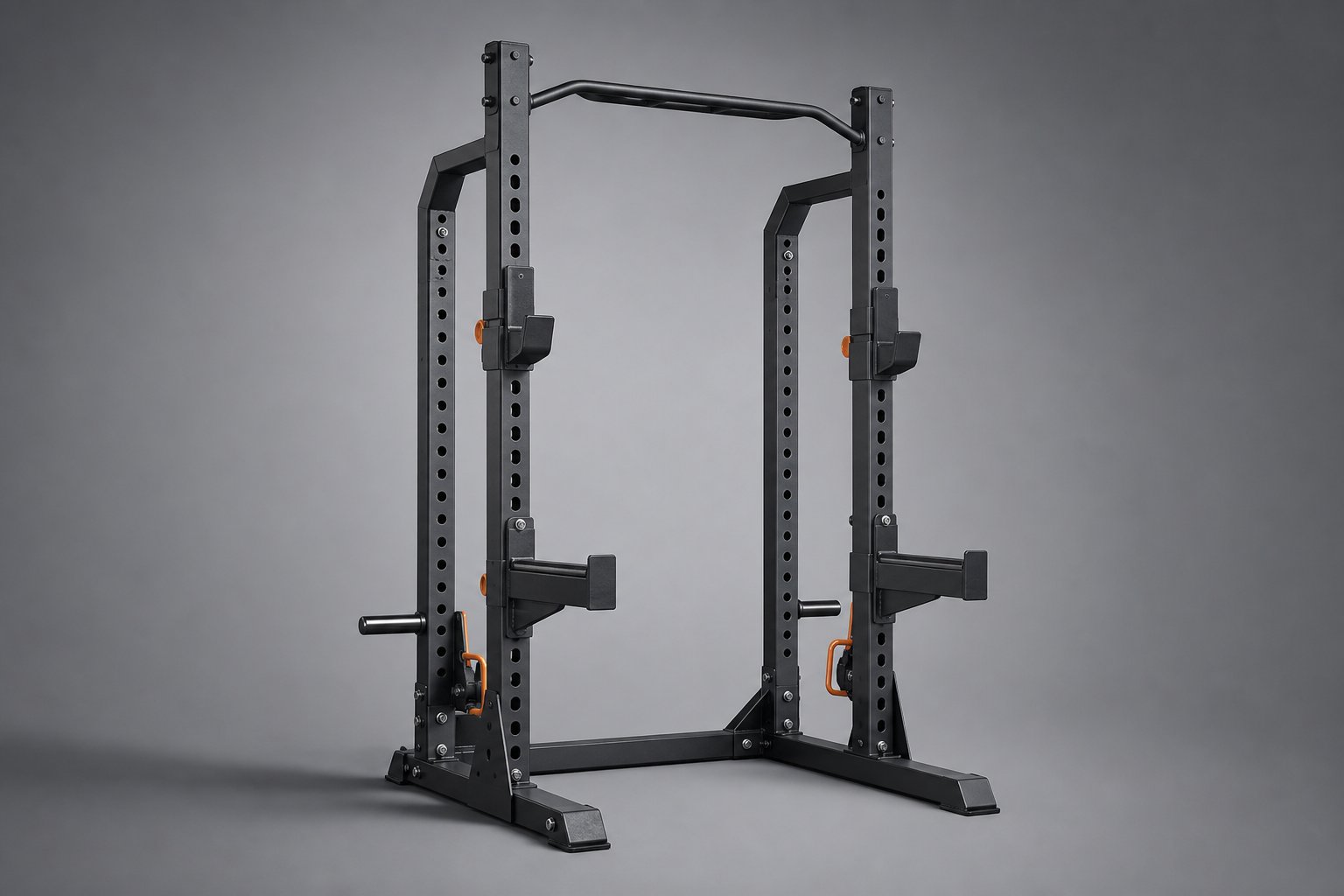
A power rack is the anchor purchase of every serious strength catalog: it is the most expensive single item a garage-gym buyer considers, the piece gym owners judge a store by, and the product whose quality shows up — or fails to — in every review that mentions bar rattle, hook play or wobble. The good news for sellers is that rack quality is not mysterious. It reduces to three families of specifications you can read on a factory drawing in five minutes: upright steel, the hole system, and load ratings with their test basis. Buyers who understand these three can tell a commercial rack from a home rack at a glance, and stores that publish them win the trust that sells the rest of the strength category around the rack. This guide explains each family, gives you a side-by-side commercial versus home comparison, and ends with a checklist you can paste into any supplier conversation.
Steel first: what the upright numbers actually mean
Rack listings love to quote steel by gauge, which conveniently means different things in different countries. The honest unit is millimeters: upright cross-section and wall thickness. Our commercial line runs 50×120 mm uprights with a 3.0 mm wall; the home line runs 50×100 mm at 2.5 mm. The cross-section height matters for front-to-back stiffness — a taller section flexes less when a loaded bar is racked hard — but the wall thickness is the quieter differentiator: it is what keeps J-hooks seated without play after a year of drops, and what lets the rack bolts hold torque. Ask any supplier for both numbers in millimeters and you will separate serious factories from assemblers in one email. While you are at it, ask how the frame is made, not just what it is made of. Laser-cut and CNC-bent members assemble square; robotic welding holds distortion to roughly 0.3 mm or less on thin-wall sections, which is what keeps uprights plumb without shimming; shot-blast pretreatment to Sa2.5 with a double powder-coat pass is what keeps the finish from chipping at the hook contact points in month three.
The hole system: the part that decides the ecosystem
The holes are the rack's operating system. Three attributes define them. Diameter, because every attachment — J-hooks, spotter arms, dip handles, landmine attachments — must seat positively without rocking. Spacing, because it decides how finely you can set bar height; well-designed racks use uniform spacing through the pulling zone with closer spacing in the bench-press band, where small height changes matter most. And numbering, the cheap feature that signals a thoughtful factory: laser-marked hole numbers let users set both uprights symmetrically and reproduce settings between sessions. For a store, the hole system is also a commercial decision: a rack whose attachments fit today and stay in production becomes an attachment business — replacement hooks, arms, handles — that outlives the original sale. Get the hole spec in writing, and get the supplier's commitment that the system will not change between batches.
Load ratings: demand the basis, not the number
A load rating without a test basis is a mood, not a measurement. Serious buyers now ask what the number refers to: a static load applied without movement, a dynamic test with the bar dropped onto the hooks, or a fatigue cycle. Usage classification helps make this concrete. The EN ISO 20957 series — the framework behind essentially every stationary training machine sold in Europe — splits equipment by use environment: Class S for professional and commercial settings such as clubs, schools and hotels, Class H for home use, with accuracy classes A, B or C layered on where relevant. Strength training equipment has its own part in the series, EN ISO 20957-2, updated in 2024. For a rack buyer, the practical takeaway is direct: a commercial placement should be buying Class S-qualified hardware with a stated load basis, and a home-line product should say Class H honestly rather than borrowing commercial numbers it cannot support. We state the class alongside the rating on our spec sheets — it is the first question serious gym buyers ask anyway.
| Spec item | Commercial line | Home line | Why it matters |
|---|---|---|---|
| Upright section × wall | 50×120 mm × 3.0 mm | 50×100 mm × 2.5 mm | Stiffness under racked loads; hook play over time |
| Usage class | Class S (EN ISO 20957-2) | Class H (EN ISO 20957-2) | Matches hardware to placement; first buyer question |
| Welding | Robotic, deformation ≤0.3 mm | Robotic, same standard | Uprights plumb; consistent hole alignment |
| Finish | Sa2.5 blast + double-pass powder coat | Same process, home palette | Chip resistance at hook contact points |
| Hole system | Numbered, uniform + tight bench band | Same system, fewer attachments | Attachment ecosystem and symmetric setup |
| Structural warranty | 5 years (indicative) | Home line 1 year (indicative) | Signals confidence in the frame, in writing |
Attachments sell the rack, and the rack sells attachments
Nobody buys a rack to own a rack; they buy it to run lifts safely, and the attachments decide how far that goes. J-hooks are the consumable — check the insert material and the wrap that protects the upright coating. Spotter arms turn a home rack into a solo-lifting rack and are the single most-cited attachment in garage-gym purchases. Dip handles, band pegs and a landmine attachment widen the exercise catalog without adding floor space. For sellers, the sequencing matters: stock the rack with hooks and arms included so the first order is complete, then merchandise the rest of the attachment line as repeat purchases. This is also where the hole-system commitment pays — an attachment sold today is a warranty on your promise that the system stays stable.
A five-question checklist for any rack supplier
Run every rack quote through five questions. One: upright section and wall thickness in millimeters, per use line. Two: hole diameter, spacing and numbering, in writing, with a commitment to consistency across batches. Three: load rating and its basis — static, dynamic or fatigue — plus the usage class under EN ISO 20957-2. Four: production process — cutting, bending, welding tolerance and pretreatment standard. Five: packaging and spare parts — export-grade cartons with drop testing, hardware packs labeled per step, and a 2 percent spare-parts allowance on first orders (indicative). A factory that answers all five without hesitation is a factory you can put your brand on.
Conclusion
Racks reward buyers who read drawings the way engineers do: section, wall, holes, class, basis. Those five data points separate commercial hardware from home hardware, honest suppliers from rebranders, and reviews that praise stability from reviews that document play. Publish them on your listings and your rack becomes the trust anchor of the whole strength category — the product that makes the bench, the bar and the plates beside it easier to sell. Send us your channel and placement profile — commercial, home or mixed — and we will quote the matching rack line with the full spec sheet attached.
Frequently asked questions
What is the difference between a commercial and a home power rack? The steel and the rating. Our commercial line uses 50×120 mm uprights with a 3.0 mm wall and carries Class S qualification under EN ISO 20957-2; the home line uses 50×100 mm at 2.5 mm, Class H. Attachments and finishes are shared so the ecosystem stays compatible.
Which load rating should I ask for? Ask for the rating and its basis together: static, dynamic or fatigue, plus the usage class. A static number without a test reference is marketing. Commercial placements should insist on Class S hardware with the basis stated on the spec sheet.
Why does hole numbering matter on uprights? Numbered holes let users set both uprights to the same height instantly and reproduce settings between sessions. It is an inexpensive factory feature that buyers notice, and it signals a controlled production line.
Are J-hooks universal between brands? No. Hook fit depends on the rack's hole diameter, spacing and upright thickness, so hooks from one brand may rock or seat loosely on another. Buy hooks matched to the rack system, and get the hole spec in writing before stocking attachments.