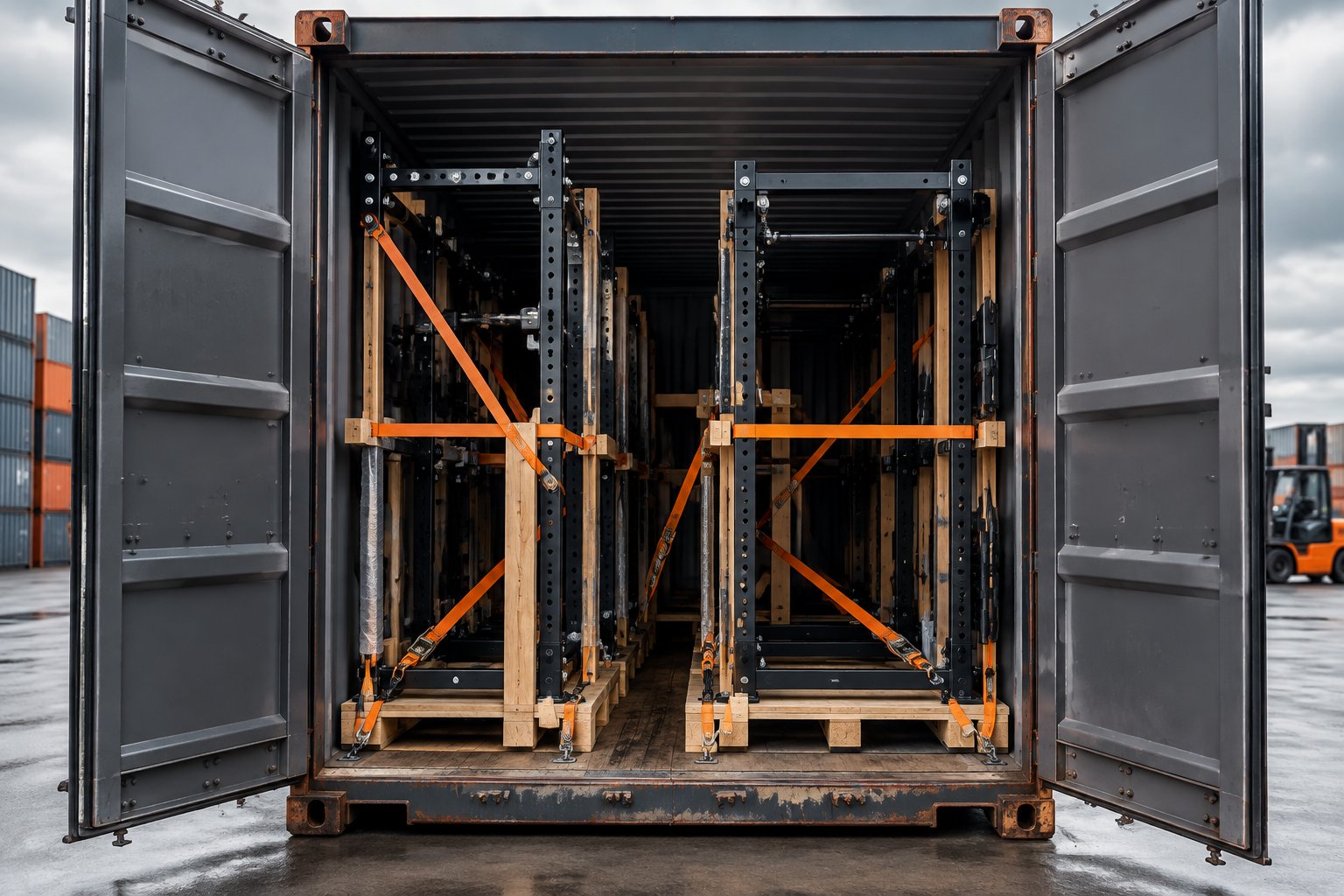
Heavy fitness equipment breaks most dropshipping logistics assumptions built around small parcels: a squat rack does not fit a courier van, a treadmill does not clear customs the way a resistance band does, and the first-mile decisions a seller makes before goods ever leave the factory determine landed cost and delivery reliability far more than any downstream carrier choice. This guide walks through the air-versus-sea decision, crating standards that actually prevent damage claims, and the planning sequence that keeps heavy equipment moving instead of stuck at a port.
Air versus sea: the decision that sets your cost structure
Air freight moves heavy fitness equipment in roughly 5-10 days but at a per-kilogram cost multiple times higher than sea freight, which makes it the right choice for urgent restocks covering a stockout, high-value low-weight items where the cost premium is proportionally smaller, or initial sample shipments where speed matters more than unit economics. Sea freight, running 25-40 days depending on origin and destination port and routing, carries a fraction of the per-kg cost and is the default mode for planned inventory replenishment where lead time can be forecast and built into a restocking calendar. Mixing modes — sea for base inventory, air for urgent top-ups — is standard practice among serious importers rather than a sign of poor planning.
Crating standards: what actually prevents damage claims
Heavy equipment crating needs to survive multiple handling transfers — forklift loading, container stuffing, ocean transit vibration, and destination unloading — each of which stresses packaging differently than the single-handling assumption behind lighter parcel packaging. A proper export crate uses a wooden frame (heat-treated per ISPM-15 for international shipping) with internal foam or corner protection at load-bearing points, and pallets should be sized to standard container dimensions to maximize load efficiency rather than leaving wasted space that shifts during transit and causes damage. A single damaged unit discovered during destination unloading can delay claims processing for an entire shipment, which makes crating quality a first-mile decision with consequences far downstream.
HS code accuracy and the documentation that prevents delays
Fitness equipment spans multiple HS code categories depending on the specific item — exercise equipment, steel structures and electronic components (for connected equipment) can each carry different codes and duty rates — and misclassification is one of the most common causes of customs delays and post-clearance duty adjustments. Confirming correct HS codes for each SKU before booking a shipment, rather than defaulting to a single code across a mixed pallet, prevents the customs holds that turn a planned 30-day sea transit into an unplanned 45-day ordeal.
Booking lead time: why 3-4 weeks matters more than it seems
Container space, particularly during peak shipping seasons ahead of Q4 retail demand, gets booked out weeks in advance, and a seller who waits until inventory is nearly depleted before booking a sea shipment routinely finds themselves paying air-freight premiums to cover the gap or facing extended stockouts. Starting the booking and documentation process 3-4 weeks before a planned shipment date, rather than the week goods are ready, absorbs the normal variability in factory completion dates and port congestion without cascading into a customer-facing stockout.
LCL versus FCL: matching container mode to order volume
Less-than-container-load (LCL) shipping lets smaller importers share container space and pay only for the volume they use, which suits early-stage sellers or smaller reorders, while full-container-load (FCL) shipping is more cost-efficient per unit once order volume justifies a dedicated container and eliminates the consolidation handling that adds both time and damage risk to LCL shipments. The crossover point where FCL becomes more economical than LCL depends on route and current freight rates, but is worth recalculating each ordering cycle rather than defaulting to whichever mode was used previously.
Insurance and liability: the line item sellers skip until they need it
Cargo insurance for heavy equipment shipments is a small percentage of goods value but covers a real risk — ocean transit damage, handling accidents and, in rare cases, total loss — that a seller absorbing the cost of a damaged container load discovers is far more expensive than the insurance premium would have been. Confirming who holds insurance liability at each stage of the shipment (factory to port, ocean transit, port to warehouse) prevents disputes over responsibility when damage does occur, which is a conversation worth having explicitly with suppliers before the first shipment rather than after a claim arises.
| Mode | Transit time | Relative cost | Best use case |
|---|---|---|---|
| Air freight | 5-10 days | High | Urgent restock, samples |
| Sea FCL | 25-40 days | Low per unit | Planned bulk inventory |
| Sea LCL | 25-40 days | Mid (volume-based) | Smaller reorders |
Conclusion
First-mile decisions — freight mode, crating standard, HS code accuracy and booking lead time — determine heavy equipment landed cost and delivery reliability more than any single downstream carrier choice. Plan sea shipments 3-4 weeks ahead, crate to survive multiple handling transfers, and confirm HS codes per SKU rather than defaulting to a single code. Tell us your target shipment volume and timeline and we will recommend the matching freight plan.
Frequently asked questions
When does air freight make sense for heavy fitness equipment despite the cost? For urgent restocks covering a stockout, high-value low-weight items, or initial sample shipments where speed outweighs the cost premium.
Why does crating quality matter more for heavy equipment than small parcels? Heavy equipment survives multiple handling transfers with different stresses, and a single damaged unit can delay claims processing for an entire shipment.
How far ahead should I book a sea shipment for fitness equipment? 3-4 weeks before the planned shipment date, especially during peak seasons, to absorb normal variability in factory completion and port congestion.