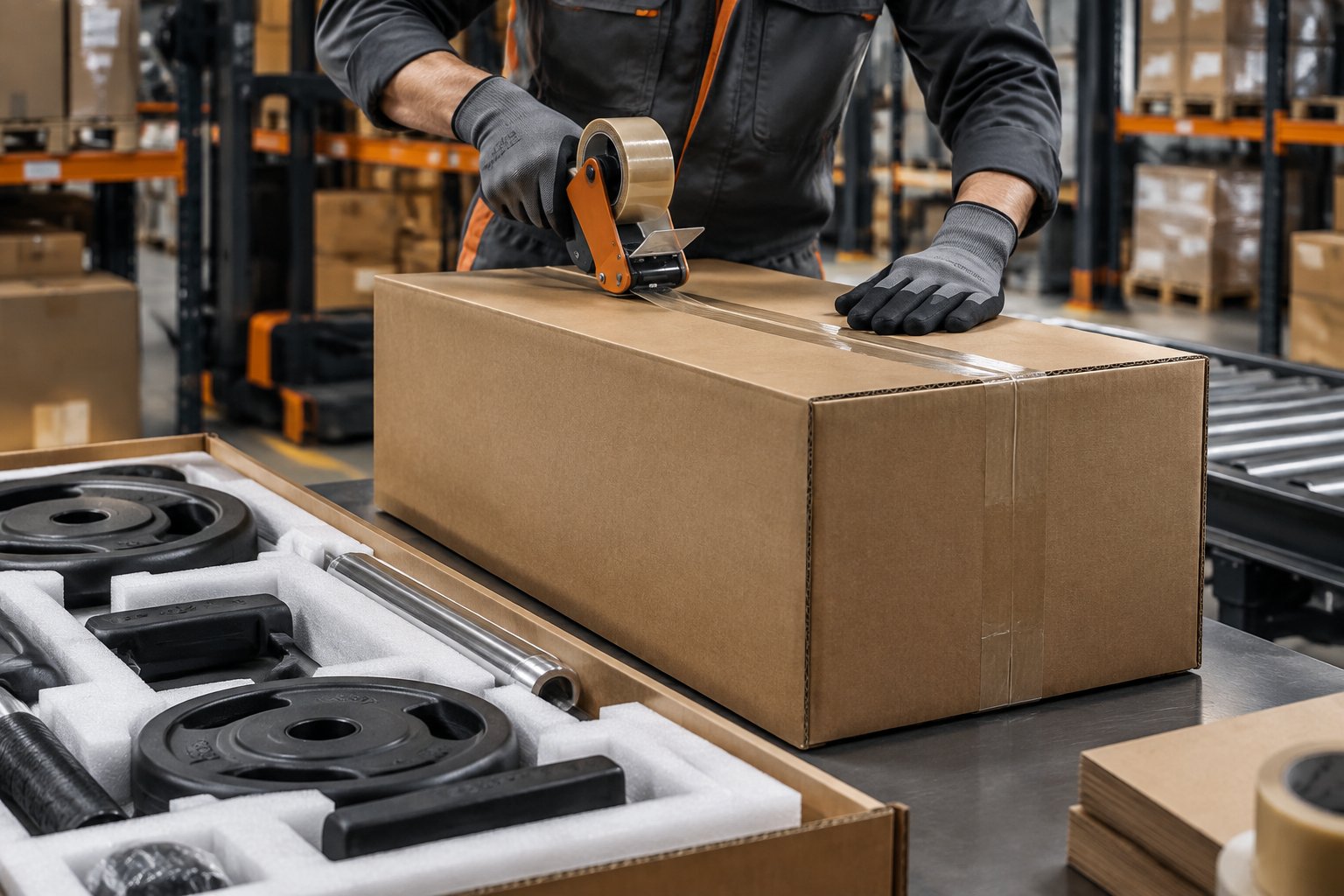
Amazon FBA's storage and fulfillment fee structure was not designed with a 45kg power rack in mind, and fitness equipment sellers who apply small-parcel intuition to FBA cost planning routinely underestimate what oversize storage actually costs relative to a dedicated third-party logistics (3PL) warehouse. The cost split between FBA and 3PL for heavy fitness equipment is not a simple cheaper-versus-more-expensive comparison — it depends heavily on inventory turnover speed and SKU size tier, and getting the comparison wrong can silently erode margin on an otherwise well-priced product line.
FBA oversize fees: where the small-parcel intuition breaks
Amazon's FBA fee structure includes a specific oversize tier for large, bulky items, and fitness equipment — racks, benches, treadmills — routinely falls into this tier where both storage and fulfillment fees are calculated differently than standard-size items. Storage fees scale with cubic volume and spike seasonally, typically rising meaningfully during Q4 ahead of peak retail demand, which means a rack sitting in FBA storage through the holiday season can accumulate fees that a seller who only modeled off-season rates did not anticipate. This is the single most common surprise for sellers moving from small parcel goods into fitness equipment on FBA.
3PL storage economics: predictable but requires more setup
Third-party logistics warehouses typically charge storage on flat or volume-tiered rates that do not carry FBA's seasonal spike, which makes cost planning more predictable across a full year rather than requiring separate Q4 budgeting. The tradeoff is integration effort: a 3PL relationship requires the seller to manage their own order routing, carrier selection and customer service escalation rather than relying on Amazon's built-in infrastructure, which is a genuine operational cost even when the dollar figures on a storage invoice look favorable.
Turnover rate: the variable that actually decides the comparison
A fast-turning SKU that sells through its inventory within weeks rarely accumulates enough storage time for FBA's oversize fees to matter much relative to the conversion and speed benefits of Prime eligibility — for these SKUs, FBA usually wins the comparison outright despite headline storage rates looking high. A slow-turning SKU that sits in inventory for months tells the opposite story: storage fees compound over that holding period until they meaningfully exceed what a 3PL's flatter rate structure would have charged for the same duration. Running this calculation per SKU, using actual or forecast turnover rate rather than a blanket assumption across the whole catalog, is what actually determines the right answer.
Prime eligibility: the conversion premium worth quantifying
FBA's Prime badge is a genuine conversion advantage that shows up in click-through and purchase-decision data across most product categories, including fitness equipment, and this benefit should be weighed explicitly against the storage-fee delta rather than treated as a vague "FBA is better for visibility" assumption. For a fast-turning SKU, the conversion premium from Prime eligibility often outweighs a modest storage-fee disadvantage; for a slow-turning SKU sitting in storage for months, the storage-fee gap can eventually outweigh the conversion benefit.
Hybrid strategies: splitting inventory across both channels
Many established fitness equipment sellers run a hybrid model: fast-turning, smaller SKUs on FBA to capture Prime conversion, and slower-turning or genuinely oversize items (full racks, heavy cardio equipment) in a 3PL warehouse with fulfillment routed to Amazon's Seller Fulfilled Prime program or to other sales channels directly. This split captures FBA's conversion advantage where it matters most while avoiding its oversize storage penalty on the SKUs least suited to it.
Building the comparison into a launch decision, not an afterthought
Modeling the FBA-versus-3PL cost comparison before choosing a fulfillment channel for a new fitness equipment SKU, using realistic turnover forecasts rather than optimistic ones, prevents the common pattern of launching on FBA by default and only discovering the oversize storage math months later once fees have already accumulated. Both channels provide fee preview calculators for exactly this purpose — entering a SKU's dimensions, weight and expected monthly sales volume produces a side-by-side cost projection that takes minutes and turns the FBA-versus-3PL decision from a matter of intuition into a matter of arithmetic, which is precisely the kind of decision arithmetic should settle.
| Factor | FBA favors | 3PL favors |
|---|---|---|
| Turnover rate | Fast-turning SKUs | Slow-turning SKUs |
| Seasonality | Off-peak storage | Q4 storage (flat rate) |
| Conversion | Prime-eligible visibility | N/A (needs other channels) |
| Setup effort | Low (built-in infrastructure) | Higher (own integration) |
Conclusion
FBA and 3PL are not simply cheaper-or-more-expensive options — the right choice depends on SKU turnover rate, seasonality exposure and how much conversion value Prime eligibility genuinely delivers for a specific product. Model the comparison per SKU using realistic turnover forecasts before launch, and consider a hybrid split for a mixed catalog. Tell us your SKU mix and expected turnover and we will help model the comparison.
Frequently asked questions
Why do FBA storage fees surprise sellers moving into fitness equipment? Oversize items fall into a different fee tier that scales with cubic volume and spikes seasonally, especially during Q4, which small-parcel sellers often don't anticipate.
Is FBA always more expensive than 3PL for heavy equipment? No - it depends heavily on turnover rate; fast-turning SKUs often favor FBA despite storage fees, while slow-turning SKUs favor 3PL's flatter rate structure.
Can sellers use both FBA and 3PL for the same catalog? Yes - a hybrid model with fast-turning SKUs on FBA and slow-turning or oversize items in 3PL is common among established fitness equipment sellers.