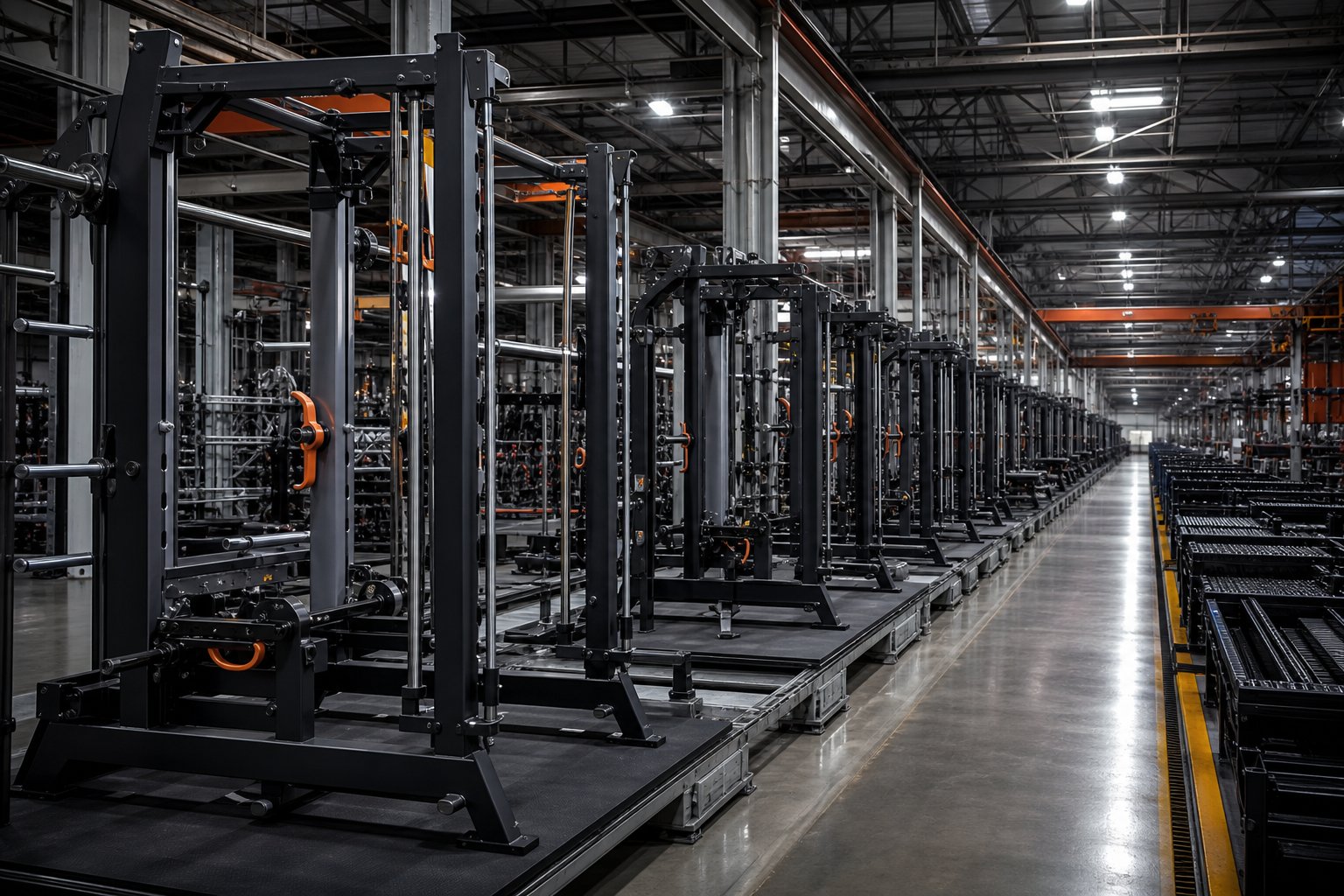
A factory audit is where sourcing marketing meets manufacturing reality, and the gap between the two is where most supplier surprises live. The 24 items in this checklist are organized so two people can run the same audit — one on site, one by video walkthrough — and reach comparable conclusions: what the factory owns versus brokers, whether quality control exists as a process or a poster, whether documents prove anything, and whether capacity claims survive arithmetic. The checklist does not replace an audit firm for major commitments; it outperforms no audit at all by a wide margin.
Equipment and capability (items 1-6)
The first six items establish what the factory physically is: (1) welding capability — robotic cells versus manual benches, and which the sample production actually uses; (2) cutting and forming equipment — laser or saw, CNC benders, ownership visible on nameplates; (3) surface treatment — an owned powder-coat line versus outsourced coating that adds a quality-control gap; (4) assembly line structure — dedicated fixtures and torque tools versus floor assembly on pallets; (5) in-house testing rigs — a load-test frame, drop-test area, cycle-test machines, whose existence predicts whether published ratings were measured or wished; (6) the warehouse — finished goods storage conditions, separation of QC-passed and pending stock. Each item photographs in seconds on a video call, and each distinguishes a manufacturer from an assembly broker more reliably than any business-license review.
Quality control as process (items 7-12)
Items 7 through 12 test whether quality control exists as a living process: (7) incoming material inspection records with actual entries, not a blank template; (8) in-process checkpoints with defined criteria between operations; (9) final random inspection using AQL sampling — ask to see the sampling plan and the last three inspection reports; (10) non-conforming product handling — a quarantine area, a disposition log, evidence that rejects are dispositioned rather than re-boxed; (11) calibration certificates for measuring tools, current not expired; (12) customer-complaint records with corrective actions — a factory that keeps complaint files and can show a closed corrective action loop is a factory that expects to be audited. The common thread: real QC leaves records, and records open for inspection are the audit's currency.
Documentation substance (items 13-18)
Items 13 through 18 verify the paperwork behind the promises: (13) business license with scope covering manufacturing, not just trading; (14) test reports per current model — named models, dated within a sensible window, from identifiable labs; (15) social-compliance basics (BSCI, Sedex or equivalent) where channels require them; (16) material certificates for key inputs — steel mill certs, coating specs; (17) the technical file linkage — whether the factory can connect its reports to the specific SKUs under quotation, not just a family of lookalikes; (18) insurance certificates covering product liability where the factory carries it. Every document gets a date and a name check, because the document world's favorite failure is the right document about the wrong product.
Capacity arithmetic (items 19-22)
Items 19 through 22 test capacity claims against arithmetic rather than brochure numbers: (19) line count and line structure, counted from the walkthrough; (20) shift pattern — actual shifts running, not aspirational scheduling; (21) cycle time per unit on the observed line, timed during the walkthrough where possible; (22) the arithmetic itself — lines times shifts times available hours divided by cycle time, reconciled against the claimed monthly output. A factory claiming 10,000 racks a month with two lines, one shift and a 40-minute cycle cannot survive its own numbers, and the reconciliation politely surfaces the gap. Capacity honesty predicts delivery honesty, which is why this section outranks the showroom in predictive value.
The video-walkthrough protocol (items 23-24)
The final items define how to run the audit remotely: (23) real-time actions — the walkthrough follows the checklist live, with the contact panning across stations, opening record books to current entries, showing machine nameplates and the QC station in use, because recorded tours stage easily and live performance does not; (24) the unscripted moment — one request outside the planned route (show the quarantine area, pull last week's inspection report) reveals whether reality extends beyond the rehearsed path. Factories performing honestly welcome the requests; brokers performing a factory schedule a second call and hope enthusiasm replaces evidence.
Scoring and the decision it supports
The checklist earns its keep in the scoring: each item pass, partial or fail, tallied per supplier and compared across candidates. The deltas are the decision: a factory scoring full on equipment but failing documentation is a manufacturing partner needing document development; one failing equipment but polished on documents is a trader with good paper. Neither score is disqualifying per se — matching the scorecard to the sourcing intent is the final step, since a buyer needing deep OEM capability reads the equipment section as gating, while a buyer of mature catalog items may weight QC and delivery records first. The audit does not decide; it informs the decision with evidence instead of brochure air.
| Section | Items | Core question |
|---|---|---|
| Equipment & capability | 1-6 | What does this factory physically own? |
| QC process | 7-12 | Does quality leave records? |
| Documentation | 13-18 | Do the papers match the products? |
| Capacity | 19-22 | Do the numbers reconcile? |
| Protocol | 23-24 | Is reality on the planned route only? |
Conclusion
Twenty-four items across equipment, process, documents and capacity turn a factory audit from a guided tour into an evidence session — on site or by video. Score, compare across candidates, and match the read to your sourcing intent. Tell us your shortlist and whether the audits will run on site or remote, and we will help you structure the scoring sheet.
Frequently asked questions
Can a video walkthrough really substitute for an on-site audit? For a structured 24-item checklist with live actions - panning, opening records, showing nameplates - it gets comparably far; for major OEM commitments, follow up with a third-party on-site audit.
What single item predicts delivery reliability best? The capacity arithmetic - lines, shifts, cycle time reconciled against claimed output - because capacity honesty and delivery honesty travel together.
What does a factory failing documents but passing equipment mean? Likely a genuine manufacturer needing document development - the opposite score pattern usually indicates a trading company with good paper.