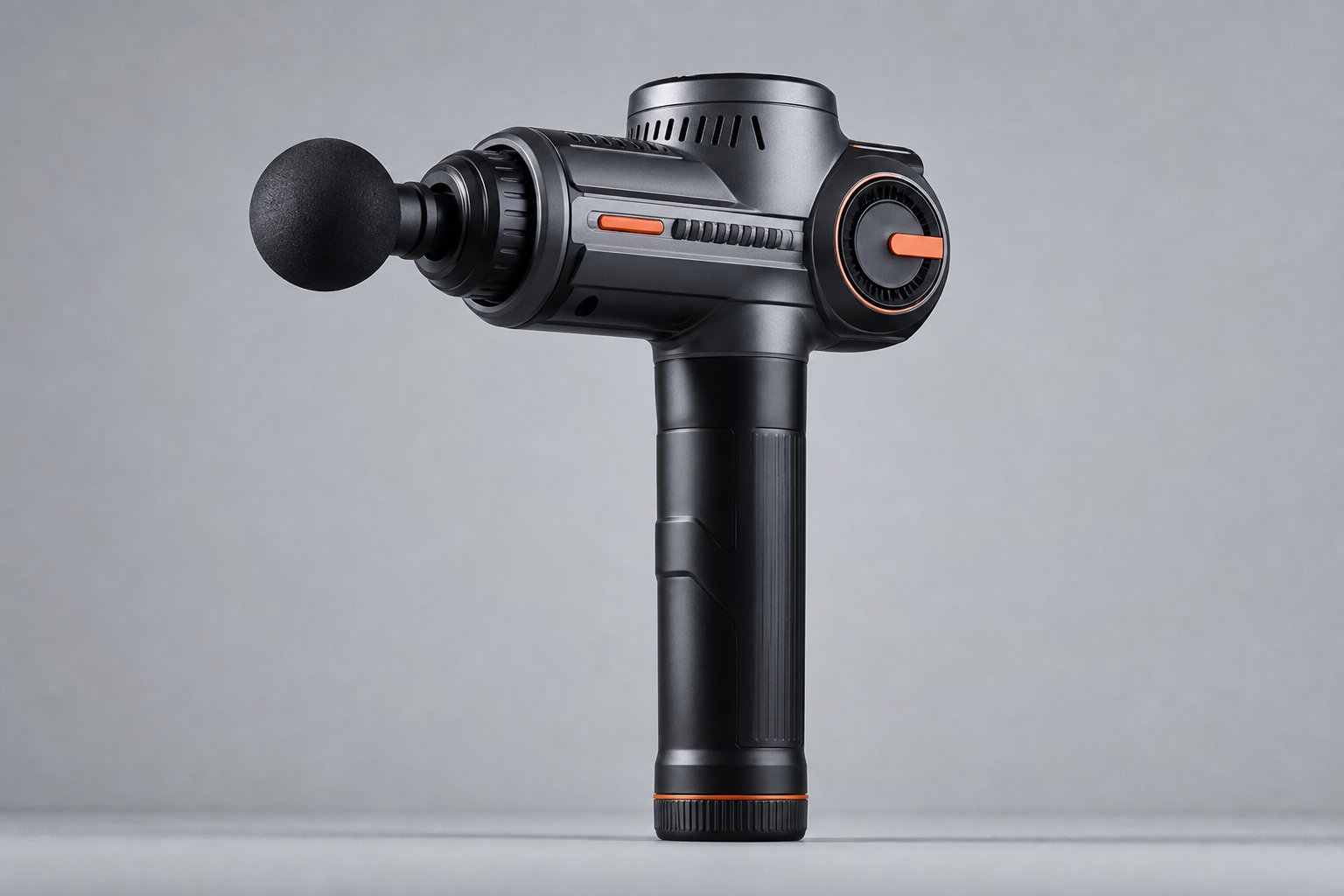
Massage gun listings are crowded with numbers that mean little on their own: "56 lbs of force," "3200 RPM," "quiet as a whisper." Buyers who sell into serious recovery channels — clinics, studios, athletic trainers — have stopped trusting adjective-only copy and started asking for four parameters that actually describe how a device performs: amplitude, stall force, stroke rate range, and measured noise level. This guide decodes each one, shows how they trade off against each other in real hardware, and gives you a three-tier comparison you can use to position a catalog honestly instead of chasing a single flattering number.
Amplitude: the number that decides how the device feels
Amplitude is the linear travel distance of the massage head, measured in millimeters, typically 10–16 mm across the category. It is the single spec most correlated with how "deep" a device feels to the end user. But amplitude only matters paired with the motor's ability to sustain it: a high-amplitude head on a weak motor will bog down and lose stroke length the instant it meets resistance from a tight muscle, which is the single most common complaint in return data for underpowered guns. Our line specs amplitude at the head, unloaded, and separately documents amplitude retention under a stated load — the figure serious buyers actually want.
Stall force: the honest toughness number
"Force" claims on massage gun listings are almost never accompanied by a test method, which makes them unverifiable. Stall force is different: it is the load at which the motor can no longer maintain stroke and stops, measured in kilograms or pounds against a calibrated fixture. A higher stall force means the device keeps working on larger muscle groups and tighter tissue without bogging down. We recommend requesting the stall force test method (static load cell vs dynamic ramp) from any supplier — a number without a method is not comparable across brands.
Stroke rate: report the range, not the peak
Stroke rate (percussions per minute) is usually presented as a single peak figure, which hides the more useful information: how many discrete speed steps the device offers and how evenly they are spaced. A device with five well-spaced steps from 1200 to 3200 RPM serves both light recovery work and deep-tissue use; a device that only offers 1800 and 3200 with nothing between leaves a real gap for post-workout use. List the full step table, not just the ceiling.
| Tier | Amplitude | Stall force | Speed steps | Noise @ load |
|---|---|---|---|---|
| Entry / mini | 8–10 mm | <15 kg | 3 fixed | 60–65 dB(A) |
| Mid / everyday | 10–12 mm | 15–20 kg | 5 stepped | 50–55 dB(A) |
| Pro / clinical | 12–16 mm | 20–27 kg | 5–10 stepped or dial | <45 dB(A) |
Noise: measure it under load, not free-running
Every massage gun is quiet when run in the air; the number that matters is noise measured while the head is pressed into a muscle surface, because that is the operating condition where brushless motor quality, gearbox tolerance and housing damping actually separate. Ask suppliers for a dB(A) figure at a stated distance (typically 0.5 m) and load, not a free-running spec — free-running numbers routinely understate real-use noise by 10–15 dB(A), enough to change a customer's perception of "quiet" to "loud."
Battery, heat and duty cycle — the specs buyers forget to ask
A brushless motor with a stated stall force still needs a battery that can deliver sustained current without voltage sag, and a housing that dissipates heat over a full session. Ask for continuous duty-cycle rating (minutes of use before thermal throttling) and cycle-tested battery life (charge cycles to 80 percent capacity), both of which distinguish clinical-grade devices from consumer units built to a lower cost target.
Attachment heads: the accessory that decides versatility
The head kit is not a throwaway accessory — it is what lets one motor serve a wide range of tissue types and buyer needs. A ball head suits large muscle groups like quads and glutes; a fork head straddles the spine safely; a bullet or cone head targets trigger points and smaller joints; a flat head is the general-purpose default. Materials matter too: silicone heads are gentler and easier to sanitize between clients in a clinical setting, while dense EVA or PU foam heads transmit more percussion energy for deep-tissue work. A six-head kit with clearly labeled use cases converts better on a listing than a generic "massage head set," because it answers the buyer's next question before they have to search for it. For private-label programs, head material and hardness (measured on the Shore A scale) are worth specifying in writing alongside the four core parameters, since a supplier that will not disclose Shore hardness on foam heads is usually cutting cost on the compound.
Conclusion
A massage gun spec sheet that lists amplitude, stall force with test method, a full stroke-rate step table and loaded-noise dB(A) tells a buyer more in four lines than a page of adjectives. Publish those four numbers on every listing and your recovery category earns the same credibility your strength and cardio lines already carry. Send us your target price tier and channel and we will match the amplitude/stall-force/noise profile to your catalog.
Frequently asked questions
Is higher amplitude always better? No. Amplitude only helps if the motor holds stroke length under load; an unmatched high-amplitude, low-torque motor bogs down on tight muscle and disappoints in reviews.
What is stall force and why does it matter more than "force" claims? Stall force is the measured load at which the motor stops moving, tested against a fixture. It is comparable across brands when the test method is disclosed, unlike marketing force numbers.
Why do two guns with the same peak RPM feel different? Because peak RPM hides step count and spacing. A device with more evenly spaced steps gives finer control across light-to-deep work than one with a wide gap between settings.