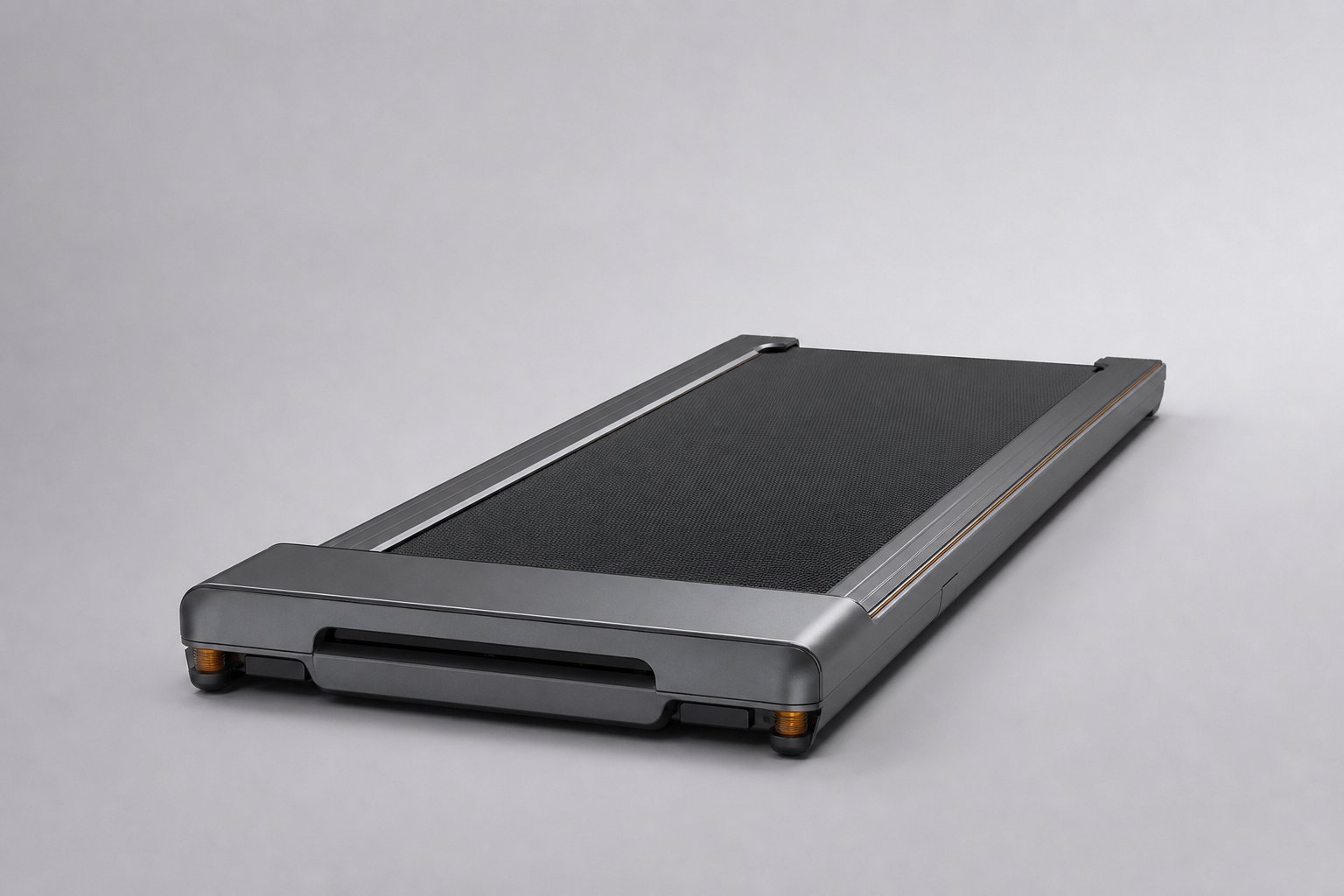
Most cardio equipment punishes online sellers: treadmills weigh as much as a refrigerator, ellipticals ride oversized freight, and every kilogram shows up again in the returns bill. The walking pad is the exception. Sliding under a standing desk and storing flat against a wall, a walking pad converts the largest sedentary audience in the market — desk workers — into cardio customers, and it does so inside a parcel logistics envelope rather than a freight one. Our cardio line specifies walking pads below 30 kg precisely because that is where the dropshipping channel opens. The treadmill family it belongs to is not a niche: China exported 16.736 million treadmill-family units in 2024 (China Sport Show industry report interpretation), and Grand View Research projects the global treadmill market growing from USD 3.3 billion in 2023 to USD 5.6 billion by 2030. This article covers what a walking pad is, why the 30 kg line decides your logistics, which four parameters to demand, and how to position the product for office and home buyers.
What a walking pad is — and who actually buys it
A walking pad is a slim, motorized treadmill stripped to its essence: a low deck, a walking-speed motor, usually a small remote or app instead of a console mast, and a fold-flat frame that slides under a bed or sofa. It is not a scaled-down running machine, and that is the point. The product succeeded by attaching cardio to a scene gyms never touched: the workday. The buyer is walking during calls, between meetings, or in front of a screen in the evening — movement added to life rather than scheduled around it. That buyer profile matters commercially. Home use accounts for 51.1 percent of global fitness equipment revenue (Grand View Research, 2025), and the home fitness equipment market itself is forecast to grow from USD 12.88 billion in 2025 to USD 22.99 billion by 2034 (Fortune Business Insights) — but within that, walking pads skew toward a buyer who would never buy a full treadmill: renters, apartment dwellers, home-office workers. When you list a walking pad, you are not competing with treadmills; you are competing with the buyer's chair.
The 30 kg line: why unit weight decides your logistics
Parcel networks were not built for fitness equipment. USPS caps parcels at 70 lb (about 31.8 kg), UPS and FedEx at 150 lb (about 68 kg), and carriers add handling surcharges once a package passes roughly 50 lb (about 22.7 kg), per the July 2025 review by fulfillment provider eFulfillment Service. A walking pad specified under 30 kg total unit weight — which is how we spec the category — keeps the product inside the parcel world: it can ship as an oversized parcel or light LTL instead of palletized freight, it is still liftable by one delivery person, and it stays inside the weight band where damage-claim math stays humane. Cross the 30 kg line and you migrate toward the treadmill's logistics: slower ocean or freight lanes, higher last-mile fees, and a delivery experience that starts generating complaints before the box is even opened. For a dropshipping catalog, the under-30 kg walking pad is the only motorized cardio product that behaves like a normal e-commerce SKU — which is exactly why it belongs at the front of a cardio line, not the back.
| Logistics class | Typical products | Carrier profile | Seller implications |
|---|---|---|---|
| Light parcel (under ~22.7 kg / 50 lb) | Bands, mats, accessories, massage guns | Standard parcel, no surcharge | Trial SKUs, fastest reviews |
| Heavy parcel (22.7-30 kg) | Walking pads, folding benches | Oversized parcel; handling surcharges may apply | Dropshipping-viable cardio; damage-tested packing essential |
| Beyond parcel (over 30 kg) | Full treadmills, spin bikes, racks | LTL or palletized freight; sea head haul for stock | Needs freight partners, overseas warehouse, delivery-tier messaging |
The four parameters that decide reviews
Across our cardio line we enforce a discipline of four honest parameters, stated in dual or explicit form wherever vendors like to hide behind one flattering number. For walking pads the four are:
- Motor rating, continuous and peak. A walking pad runs for hours at a steady load, so the continuous rating matters more than the peak. Demand both figures in writing; a sheet that lists only peak is a warning sign.
- Deck and belt construction. The running surface's layer count determines cushioning and quiet running. Ask for the layer breakdown, not just a claim of multi-layer design.
- Noise in dB at a stated condition. This product lives beside phone calls. State measured noise at a defined walking speed; buyers will test it on day one and reviewers will publish it.
- Total unit weight and folded dimensions. Weight decides the shipping class; folded thickness decides whether the product actually fits the apartment scene it is sold into.
Behind the sheet, the manufacturing base matters. Around Xiamen — Asia's largest fitness equipment manufacturing and export base — roughly six of every ten home treadmills sold worldwide are made, and the cluster can source 80 percent of core components within three kilometers in thirty minutes, per the Xiamen Investment Promotion Center. Depth like that is why motor, belt and noise performance keep improving in this category faster than any single factory could manage alone.
Positioning: office scene first, fitness second
The strongest walking-pad listings do not sell exercise; they sell a workday upgrade. Three positioning rules follow from the buyer profile. First, lead the gallery with the under-desk and folded-under-the-sofa shots, not the workout shot — the buyer is visualizing their own desk, not a gym. Second, publish the honest parameter set directly in the listing: continuous motor rating, deck layers, dB figure, folded height. This category attracts exactly the spec-literate buyer who abandons carts over a missing number. Third, write the delivery expectation plainly — this is a heavy parcel, it ships tracked, and someone may need to help carry it — because surprise-at-the-door is the most preventable negative review in this weight class. None of this requires inventing claims; it requires publishing the parameters you already demanded from the supplier.
Conclusion
Walking pads are the lowest-friction entry into cardio retail: a real market behind them, a buyer the treadmill never reached, and a weight spec — under 30 kg — that keeps them inside parcel logistics where reviews accumulate fastest. Source on the four honest parameters, list the office scene first, and set delivery expectations before checkout. If you tell us your market and channel, we will return matched walking-pad specifications — motor dual ratings, deck layers, dB, folded geometry — with indicative quotes and a packaging spec that survives the parcel journey. Terms run indicative at 100 units for stocked private label, 48-hour dispatch on in-stock goods; final terms are confirmed in a formal quotation.
Frequently asked questions
Why does 30 kg matter so much for walking pads? Carrier handling changes there: USPS caps parcels at 70 lb (31.8 kg), UPS and FedEx at 150 lb, and surcharges start near 50 lb (22.7 kg). Under 30 kg a walking pad ships as a heavy parcel; above it you drift into LTL and freight with higher last-mile cost and harder delivery experiences.
Are walking pads suitable for running? They are designed for walking and light brisk walking in office and apartment scenes. Buyers who want running should be directed to folding treadmills with appropriately rated motors — overselling a pad as a runner generates returns.
Which specs should a walking pad listing publish? Motor continuous and peak ratings, deck and belt layer construction, measured noise in dB at a stated walking speed, maximum user weight, total unit weight and folded dimensions. Honest dual motor ratings are the single biggest trust signal in this category.
Where are walking pads mainly manufactured? In the Xiamen cluster — Asia's largest fitness equipment manufacturing and export base, producing roughly six of ten home treadmills worldwide and sourcing 80 percent of core components within three kilometers, per the Xiamen Investment Promotion Center.