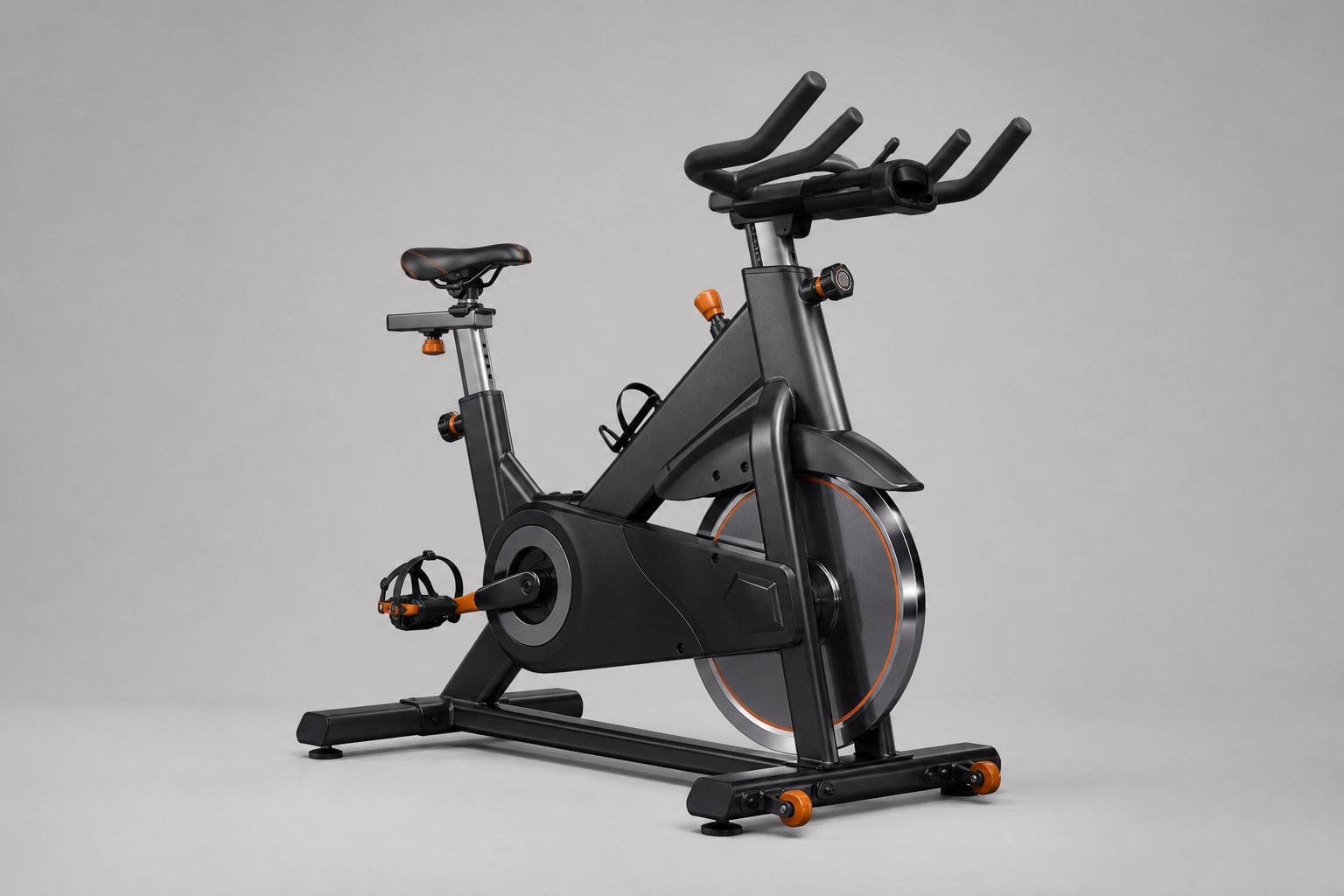
Request quotes for indoor cycles from ten suppliers and you will receive ten different flywheel numbers — and many buyers treat the biggest one as the best bike. That habit costs margin. Flywheel mass matters, but it is only one of the specifications that decide how a spin bike feels, sells and survives review season. The band we build the FITORIGIN cardio line around is 13-20 kg, because it covers what home riders and most studios genuinely need: below it the pedal stroke degrades in ways customers notice within a week, and far above it you pay freight for inertia most riders cannot feel. This article explains what a flywheel does, why 13-20 kg is the practical band, how drive and resistance change the picture, and which checkable parameters to demand before you list an indoor cycle.
What a flywheel actually does
The flywheel is the mass your legs accelerate, and its job is to smooth the pedal stroke. A rider does not produce constant torque; each leg pushes, then relaxes, twice per revolution. A heavier wheel stores more rotational energy, so momentum carries the pedals through the dead spots and the stroke feels round and stable. A very light wheel accelerates easily but also decelerates easily, which riders describe as flat or twitchy. Two things follow for anyone selecting stock. First, flywheel mass is about feel and inertia, not resistance: the braking force that makes the workout hard comes from the resistance system, not from the kilogram figure. Second, mass must be balanced and properly bearing-mounted to help — a heavy but poorly balanced wheel produces the wobble and noise that one-star reviews are made of. Judge flywheels as a system with the frame, bearings and brake, never as a lone number.
Why 13-20 kg is the practical band
Our cardio category pages list indoor cycles with flywheels from 13 to 20 kg, and that range is deliberate. Around 13 kg with a well-balanced perimeter-weighted wheel and a smooth belt drive, a home rider gets a genuinely road-like stroke; most apartment buyers never ask for more. From 16 to 18 kg the inertia holds through standing climbs and intervals, which is where frequent home users and small studio groups land. At 19-20 kg you are specifying bikes that survive daily group classes — the studio tier, typically specified to EN ISO 20957 Class S (professional or commercial use) rather than Class H (home use). Wheels well under 13 kg can still sell in the ultra-budget tier, but expect the feel to be the most common complaint; wheels far above 20 kg add ocean freight and assembly burden for gains most riders cannot perceive. Context matters too: cardio equipment is the largest slice of the global fitness equipment market at 55.2 percent of 2025 revenue per Grand View Research, so this is a category worth specifying carefully rather than competing on a single number.
| Flywheel band | Typical setup | Rider profile | Channel and duty class |
|---|---|---|---|
| 13-15 kg | Belt drive, magnetic resistance, multi-level control | Home riders, apartment cardio, beginners to intermediate | Home line, EN ISO 20957 Class H; parcel or LTL-friendly packaging |
| 16-18 kg | Belt drive, magnetic resistance with fine increments | Frequent home users, small group classes | Premium home / light commercial; oversized-parcel or sea + warehouse |
| 19-20 kg | Belt or chain drive, magnetic or friction | Studios, daily group cycling | Commercial line, Class S; sea head haul + overseas warehouse |
Drive system: belt versus chain
The drive connects your legs to the flywheel. A belt drive runs a reinforced polyurethane or rubber belt over the perimeter; it is quiet, needs no lubrication, and tolerates sweat and dust far better than a chain. A chain drive delivers the road-bike texture many enthusiasts ask for, but needs periodic tensioning and lubrication and transmits more noise into an apartment. For e-commerce, the choice is mostly decided by where the bike will live: home listings should default to belt drive, because noise and maintenance are the two complaints that follow indoor cycles into reviews. Chain drive remains a legitimate spec for studio bikes where riders expect the road feel and a technician handles maintenance — but then spare belts or chains must be part of the parts package you negotiate with the supplier.
Resistance: magnetic versus friction
Resistance is what makes the workout hard, and here the trade-offs are the sharpest. Friction resistance presses a pad against the flywheel: it is cheap, gives an immediate road-like load, and fades only as the pad wears. Pads are consumables, sweat corrodes the contact area, and load consistency drifts as the pad seats in. Magnetic resistance works without contact — a magnet moves closer or farther from the wheel, so there is nothing to replace, the load stays consistent, and the ride is near-silent. It costs more per unit, but it converts into better reviews and a shorter spare-parts tail. Our guidance for sellers is blunt: default your home catalog to magnetic, keep friction only in entry price tiers where the lower unit cost carries the listing, and if you do list friction bikes, contract for pad supply up front so post-sale support does not depend on ad-hoc sourcing.
The parameter sheet to demand before listing
Across our cardio line we hold suppliers to a discipline of four honest parameters — stated explicitly wherever vendors hide behind one flattering number — and the same discipline maps directly onto indoor cycles:
- Flywheel mass in kilograms, plus whether weighting is perimeter or center.
- Resistance system named explicitly (magnetic or friction), with the number of control levels.
- Drive type (belt or chain) and expected noise in dB at a working cadence — state the measurement condition, not just a number.
- Maximum user weight and the frame's duty class per EN ISO 20957 — Class S for commercial, Class H for home.
Behind the sheet, inspect the things a spec sheet hides: frame steel cut and formed on CNC lines, robotic welding on the thin-wall sections, powder coating over a blasted (Sa2.5) surface, and export packaging that has actually passed a drop test — three-layer corrugated with foam inserts, crated for sea freight where applicable. Insist on batch-by-batch inspection records. A supplier who cannot produce this list is selling you a listing, not a bike.
Matching the spec to your channel
Translate the bands into a catalog decision. For a home e-commerce line, lead with 13-15 kg belt-driven magnetic bikes: they ship as oversized parcels, assemble with common tools, and generate clean reviews when the parameter sheet is honest. For a premium home or light-commercial tier, 16-18 kg with fine magnetic increments justifies a higher price point and faces far less comparison pressure. For studio and gym customers, specify 19-20 kg Class S bikes, order by container with sea head haul and overseas-warehouse support, and bundle spare pads, belts and pedals into the deal. Commercial terms across these tiers run on the same indicative frame: stocked private-label orders from 100 units, sampling in 7-12 days, production in 20-35 days, and 48-hour dispatch on in-stock labeled goods — all to be confirmed in a formal quotation before you commit listings.
Conclusion
A spin bike is a system: flywheel for inertia, drive for delivery, resistance for load, frame for trust. The 13-20 kg band is where that system stays honest for home through studio use — big enough to feel right, small enough to ship sensibly. Pick the band by rider profile, pick belt and magnetic for anything that lives in an apartment, and buy on a written parameter sheet instead of a single flattering number. If you send us your channel and price tier, we will return matched flywheel, drive and resistance specifications with indicative quotes — as a source supply chain partner, we would rather win the listing with honesty than with kilograms.
Frequently asked questions
Is a heavier flywheel always better on a spin bike? No. Mass smooths the pedal stroke, but balance, bearing quality and the resistance system decide the ride. Beyond the 13-20 kg band you mostly add freight and assembly burden, while noise and consistency — driven by drive and resistance type — determine reviews.
What flywheel weight suits home users versus studios? Home riders are well served at 13-15 kg with a belt drive and magnetic resistance; frequent users and small groups at 16-18 kg; daily studio classes justify 19-20 kg bikes specified to EN ISO 20957 Class S.
Magnetic or friction resistance — which should I stock? Default to magnetic for home channels: contactless load stays consistent, runs near-silent and has no consumable pads. Friction remains viable in entry price tiers, but contract for pad supply up front.
Which parameters should a supplier sheet include for an indoor cycle? At minimum: flywheel kg and weighting type, resistance system and levels, drive type, noise in dB at a stated cadence, maximum user weight, and the EN ISO 20957 duty class (S or H). Ask for batch inspection records and drop-tested export packaging.