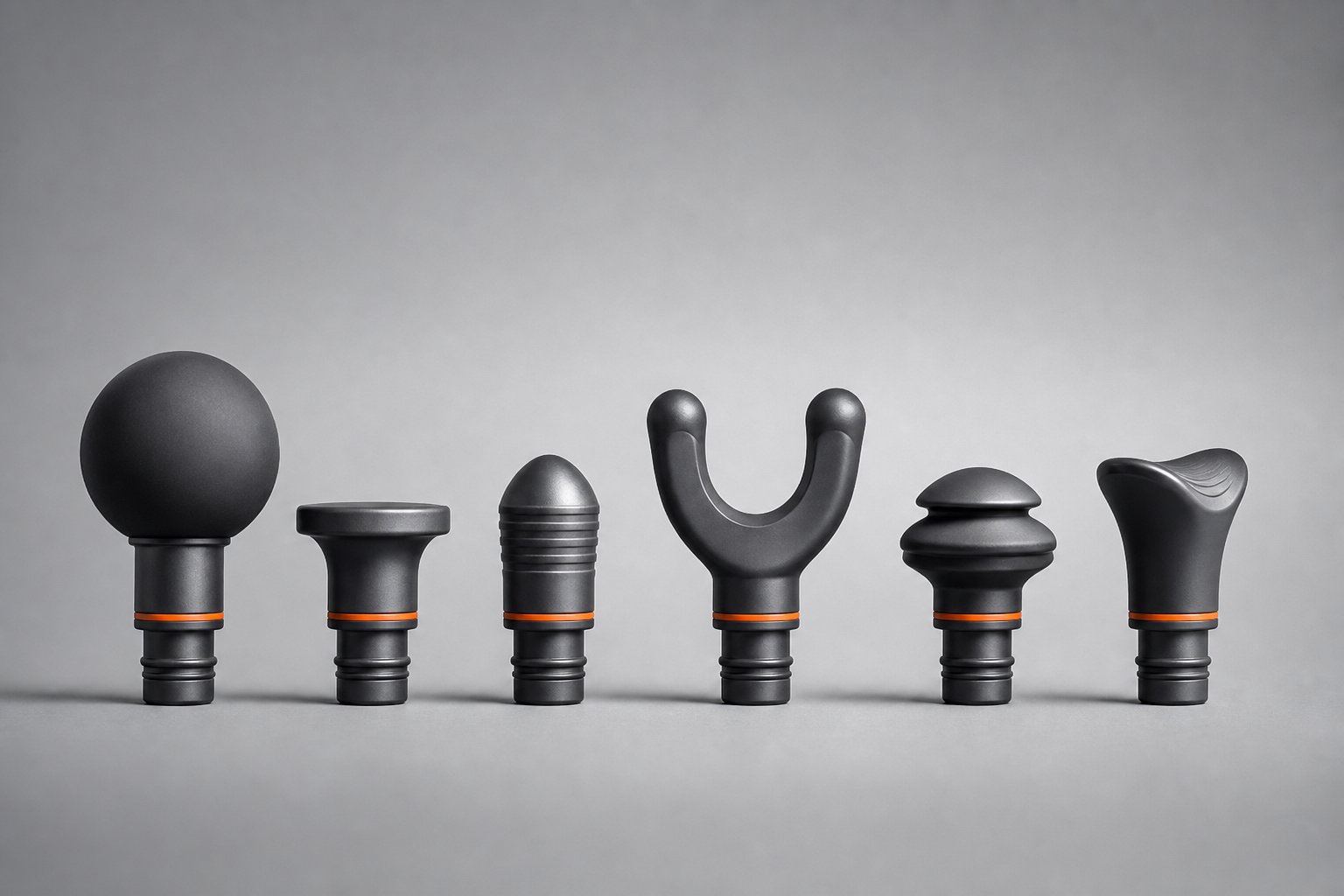
A massage gun head kit is sold as an accessory, but it is functionally the interface between the motor's percussion and the specific tissue type a user is targeting, which means the six common head shapes are not interchangeable variety for variety's sake — each solves a distinct anatomical problem. Understanding what each shape actually does, and the material choices behind them, turns a generic "six-head kit" listing into one that answers a buyer's next question before they ask it, and gives private-label buyers a real basis for specifying head material and hardness rather than accepting whatever a factory defaults to.
Ball head: the default for large muscle groups
Choosing which head to feature first in kit photography and copy is not a trivial decision — it sets buyer expectations for the whole kit. The ball head is the most-used attachment in almost every kit and the one most buyers reach for first, because its rounded surface distributes percussion evenly across large muscle groups like quads, glutes and hamstrings without concentrating pressure on a single point. It is the head most kits should lead with in marketing imagery, since it represents the majority use case for a general-purpose recovery buyer rather than a specialist or clinical user.
Fork head: the spine-safe design
The fork head splits into two prongs specifically to straddle the spine, allowing percussion therapy along the muscles on either side of the vertebrae without direct bone contact — a genuinely useful design solving a real safety problem, since direct percussion on the spine itself is uncomfortable and something users instinctively avoid without the right tool. This head is disproportionately valued by buyers who train back-heavy programs and by clinical or physical-therapy-adjacent users who need paraspinal muscle access.
Bullet and cone heads: precision for trigger points
Bullet or cone-shaped heads concentrate percussion into a small contact area, making them the tool of choice for trigger-point work, deep tissue knots, and small joint areas like the hands or feet where a broad head cannot reach effectively. These heads deliver more localized intensity per unit area than a ball head at the same amplitude setting, which means they should be marketed with a caution about starting at lower intensity settings for sensitive users rather than assuming maximum settings suit every head shape equally.
Flat head: the general-purpose workhorse
The flat head covers a broad surface area at moderate intensity and works reasonably well across most muscle groups without the specificity of a ball or bullet head, making it a genuine all-purpose option for buyers who want one head that handles most situations adequately rather than several heads each optimized for a narrower use case. It is a sensible second head to feature after the ball head in kit marketing.
Cushion and wedge heads: sensitive areas and bony structures
Cushion or air-filled heads soften percussion intensity for use on sensitive areas — the shins, the face for buyers using facial massage guns, or any region where a firm head would be uncomfortable rather than therapeutic. Wedge heads, with a flatter angled surface, are designed for areas where bone structure curves against a flat plane, notably the shoulder blades and the IT band along the outer thigh, where a rounded head cannot maintain consistent contact.
Material and hardness: the private-label spec worth writing down
Head material — silicone versus dense EVA or PU foam — and hardness, measured on the Shore A scale, determine both comfort and how much percussion energy actually transfers into tissue versus being absorbed by the head material itself. Silicone heads are gentler and easier to sanitize, which matters for clinical or multi-user settings; denser foam heads transmit more energy for deep-tissue work but feel harsher on sensitive areas. For private-label programs, specifying Shore hardness in writing for each head, rather than accepting a factory's unstated default, is the difference between a kit that performs consistently across production batches and one that varies unpredictably.
| Head shape | Best for | Material tendency |
|---|---|---|
| Ball | Large muscle groups | Medium-density foam |
| Fork | Paraspinal muscles | Firm foam or silicone |
| Bullet/cone | Trigger points, small joints | Firm foam |
| Flat | General purpose | Medium-density foam |
| Cushion | Sensitive areas | Soft silicone |
| Wedge | Shoulder blades, IT band | Firm foam |
Conclusion
Six heads, six real jobs — labeling a kit by use case rather than shape alone gives buyers the information a generic "6-piece head set" leaves them to guess at, and sets private-label programs up to specify material and hardness deliberately rather than by factory default. Tell us your target use case mix, intended buyer segment and channel and we will recommend the matching head set and hardness spec.
Frequently asked questions
Which massage gun head should I use most often? The ball head is the default for large muscle groups like quads and glutes, and the head most general-purpose users reach for first.
What is the fork head specifically designed for? It straddles the spine to allow percussion on paraspinal muscles without direct contact with the vertebrae themselves.
Why does head hardness matter for private label? Shore A hardness determines how much percussion energy transfers into tissue versus being absorbed by the head; specifying it in writing keeps production batches consistent across every reorder, not just the first sample run.