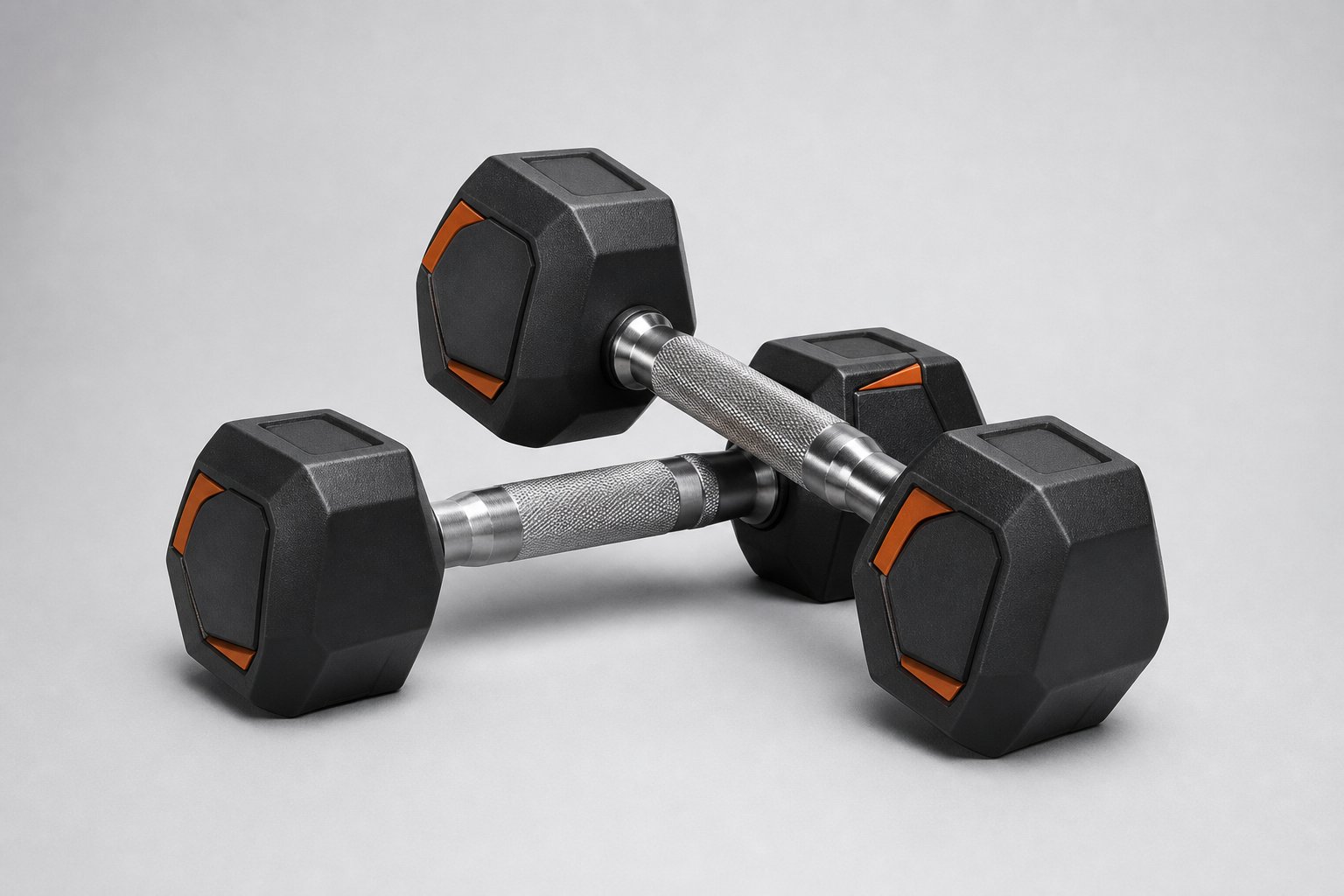
Dumbbells look like the simplest product in a fitness catalog — a handle and some iron — and that simplicity is why finish choice gets treated as a cosmetic decision. It is not. The finish decides how loud the product is when dropped on a wooden floor, whether it marks tiles, whether it smells in a sealed shipping carton, how it survives sweat in a commercial gym, and how much of your retail price the courier consumes. Our free-weights line is built on rubber-coated and chrome-plated dumbbells from 1 to 50 kg, with vinyl and urethane available through the same supply chain — and every batch ships with weight-error sampling inspection because in this category the number on the head is a promise. This article compares the four finishes across the dimensions buyers actually complain about — noise, floor protection, odor, durability, cost — and ends with a channel-matching recommendation you can apply to your catalog this week.
Why finish is a business decision, not a cosmetic one
Two numbers decide most dumbbell returns, and neither is printed on the product. The first is decibels: home buyers train in apartments, above neighbors, on laminate floors, and a loud dumbbell generates complaints no spec sheet can offset. The second is weight accuracy: a pair bought to be symmetric must be symmetric, and mismatched pairs are a quiet but reliable source of one-star reviews. Around those two, the finish drives odor complaints (rubber compounds vary widely in smell), floor damage (bare steel and chrome mark; rubber and urethane do not), and freight share (denser, more compact heads and better cartonization lower per-unit shipping). In other words, the finish you choose determines which complaint categories your customer service team inherits. Choose the complaints you can afford, and pick the finish accordingly.
The four finishes, compared
Here is the comparison as we brief catalog buyers. Cost tiers are relative judgments from our sourcing experience (indicative), not quotations.
| Attribute | Rubber-coated (hex) | Vinyl-dipped | Chrome-plated | Urethane-encased |
|---|---|---|---|---|
| Noise on drop | Low — rubber absorbs impact | Moderate at light weights | High — metal on floor | Low to moderate |
| Floor protection | Good; hex shape prevents roll | Good at light weights | Poor without mats | Very good |
| Odor risk in carton | Varies by compound — specify low-odor rubber | Low | Low | Low |
| Sweat and chalk resistance | Good | Poor — coating scuffs | Good, but plating shows wear | Excellent — commercial standard |
| Relative cost tier | Low to mid | Lowest | Mid | Highest |
| Channel fit | Home e-commerce, garage gyms | Light home use, rehab, beginners | Studios, aesthetic-led listings | Commercial gyms, hotels, PT studios |
Our stocked core covers rubber-coated and chrome-plated lines from 1 to 50 kg; vinyl and urethane are sourced through the same cluster on request. That is a supply decision, not a verdict against the other two — it reflects where order volume concentrates.
Noise and floors: the filters that decide home channels
If your traffic is home users — and for most e-commerce sellers it is — noise and floor protection do more for reviews than any performance spec. Rubber hex dumbbells dominate the home segment for a reason: the coating absorbs impact sound, and the flat hex faces stop the classic rolled-off-the-bench escape across a wooden floor. Chrome is the opposite case: it photographs beautifully and its slim heads feel precise in hand, but on a hard floor it is loud and it marks. If you list chrome into home channels, plan to bundle a training mat and say so in the listing — the bundle converts a complaint risk into an attach-rate sale, and pairs naturally with the yoga and mat categories in our catalog. Vinyl-dipped light dumbbells sit at the very light end: quiet and friendly for beginners, physical-therapy style work and aerobic classes, but the thin coating is not designed for drops or heavy progression, so position them honestly as light-training tools.
Odor, sweat and commercial duty
Three environment tests separate the finishes further. First, odor: rubber compounds differ widely, and a container sealed for weeks of ocean freight concentrates whatever the compound releases. Specify low-odor rubber with the supplier and open-box inspect a sample from each production batch before it ships — this is a standard request we handle at the sampling stage. Second, sweat and chalk: commercial environments are chemically hostile. Urethane earns its premium here — it resists sweat, cleaning agents and chalk, keeps its color, and does not pick up the gray polish that rubber develops under barbells. It is the finish for hotels, PT studios and gym floors where equipment is used daily by strangers. Third, plate wear: chrome handles honest daily use, but plating wears visibly at the knurl over years of commercial service — another reason chrome belongs in studio and aesthetic-led channels rather than heavy-duty rental fleets.
Weight tolerance and the QC that backs the number
Whatever the finish, the number cast into the head is a contract with the buyer. Our free-weights category runs weight-error and bore-tolerance sampling inspection on every batch — pairs must match, and sets must step consistently, because progression is the entire point of the product. When you qualify a supplier, ask three questions: what tolerance the foundry holds, how pairs are matched before packing, and whether you can see the batch inspection record for your order. A supplier who cannot answer the second question is reselling castings, and the mismatch pairs will land in your reviews. Handle geometry matters too: a medium-depth knurl suits bare hands in air-conditioned studios, while home users lifting without chalk benefit from slightly deeper texture — small spec choices, but they show up in comfort scores across hundreds of reviews.
Logistics: the pair math and the 50 lb wall
Dumbbells ship in pairs, so every unit doubles: a 12 kg pair is two cartons or one double carton at 24 kg plus packaging. Carriers change their behavior along the way — USPS caps parcels at 70 lb (about 31.8 kg), UPS and FedEx at 150 lb, and handling surcharges begin near 50 lb (about 22.7 kg), per eFulfillment Service's July 2025 heavy-gear review. Two practical consequences. First, the heaviest dumbbells you can realistically parcel are light-commercial pairs; beyond that, pairs move by LTL or by the pallet, and stocked inventory in an overseas warehouse beats per-order parcel economics. Second, cartonization is a real cost lever: compact heads and nested packing reduce dimensional weight, which is why we quote dumbbells with a packing spec, not just a unit price. For marketplace testing, start with pairs in the golden parcel band, then graduate the catalog upward as reviews accumulate.
Conclusion
Match the finish to the channel and the complaints disappear before they exist: rubber hex for home e-commerce, vinyl for the light-rehabilitation end, chrome for studio and aesthetic-led listings, urethane for commercial floors. Then buy on evidence — batch weight sampling, low-odor specification, and a packing quote that acknowledges the 50 lb wall. Tell us your channel and target price points, and we will return a finish-and-weight-range recommendation with indicative quotes and inspection terms, as a source supply chain partner serving the free-weights category from inside China's manufacturing clusters.
Frequently asked questions
Which dumbbell finish should a home-fitness store stock first? Rubber hex. It is quiet on hard floors, the hex shape prevents rolling, its cost tier is efficient, and it avoids the two most common home complaints — noise and floor marks. Chrome suits studios and aesthetic-led listings if paired with mats.
Do rubber dumbbells smell, and how is odor controlled? Rubber compounds vary; low-grade compounds release noticeable odor, especially after weeks sealed in a container. Specify low-odor rubber and open-box inspect a sample per production batch before shipment.
What is urethane for, if rubber is cheaper? Urethane is the commercial-grade finish: it resists sweat, chalk and cleaning chemicals, keeps its appearance for years of daily multi-user service, and protects floors. For hotels, PT studios and gyms, it outlasts cheaper finishes by a wide margin.
How is dumbbell weight accuracy controlled? Through batch-level sampling inspection of weight error and pair matching, plus bore tolerance checks on relevant lines. Ask suppliers for the inspection record of your specific batch — pair mismatch is a leading silent cause of negative reviews.