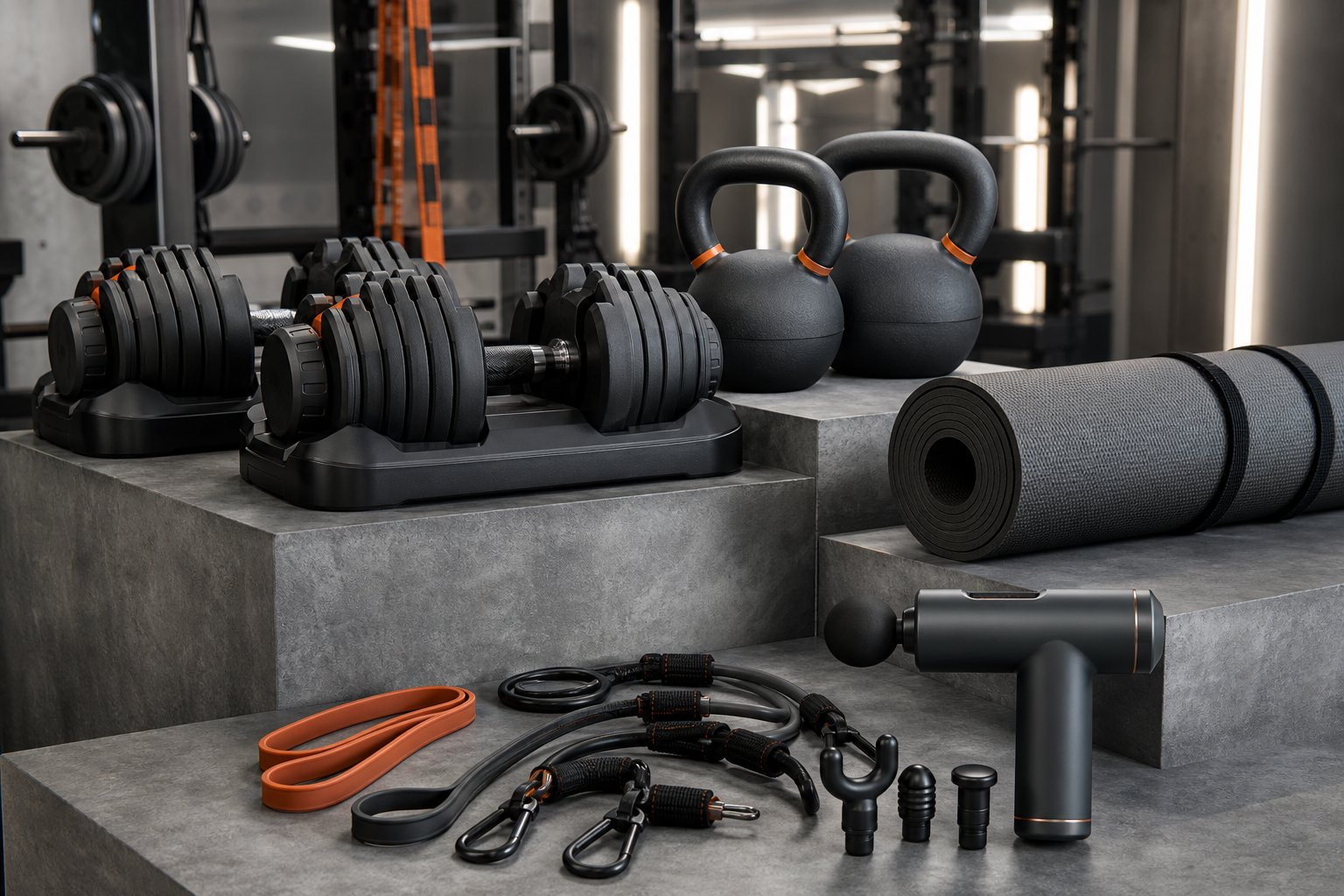
Average order value is the metric most catalogs try to lift with discounts, which trades margin for volume and trains customers to wait for promotions. The alternative — bundling accessories that the buyer functionally needs anyway — lifts AOV without a discount because it completes the purchase rather than cheapening it: the jump rope goes with the mat, the mat goes with the bands, and the customer who buys one and sees the pairing is making a decision they would have made eventually anyway. This guide covers the bundling patterns that work for fitness catalogs and the placement logic that makes them convert.
Functional pairing: complete the use case, not the cart
The bundling pattern that consistently converts is functional completion: pair the accessory that the main item's actual use requires or strongly rewards. Resistance bands pair with a mat because band work happens on the floor; jump ropes pair with starter kits because conditioning is the gap strength-only setups leave; dumbbells pair with a storage rack because every dumbbell owner eventually trips over the pile on the floor. Each pairing answers the question of what the buyer will need next anyway, which is why it converts without a discount — the customer is not buying more, they are buying done. Price-paired bundles by contrast pair whatever has margin to spare, and customers can smell the difference.
Usage sequencing: moving the predictable next purchase forward
Every fitness catalog has predictable sequences: the band buyer adds a door anchor within weeks, the yoga mat buyer adds blocks, the kettlebell buyer adds a second weight within a quarter. These sequences exist whether or not the seller monetizes them, and a bundle simply moves the second purchase forward in time and attaches it to the first order's momentum. The data to build sequence bundles comes free from the seller's own order history — which items co-occur in later orders from the same customer — and where that data is thin, category logic fills in: every experienced catalog owner knows the sequences of their own niche even before the numbers confirm them.
Placement: the bundle lives next to the main item
A bundle that lives on a separate promotions page converts at near zero because nobody visits with bundle intent; the same bundle placed on the product page beside the main item, with a single add-both action, converts at meaningful rates because it appears exactly when the buyer is imagining the use case. Checkout is the second placement: the main item in cart should surface its natural companion one time, pre-selected or one-click, without the repetitive nagging that trains customers to dismiss the module. The placement principle is presence at the moment of intent, and intent peaks on the product page and once at checkout — nowhere else.
Fulfillment arithmetic: bundles that survive the margin math
A bundle's AOV lift is only real if fulfillment does not eat it: items that ship in the same box or pick from the same warehouse zone add almost no incremental cost, while bundles combining items with different shipping profiles — a mat with a kettlebell, say — can trigger dimensional-weight jumps that consume the margin the bundle was meant to add. The disciplined practice is checking the shipping profile of every proposed bundle before launching it: combined weight, combined dimensions, and the actual incremental freight against the incremental revenue. Bundles that pass the arithmetic get launched; bundles that fail it get redesigned around items that share a box.
Pricing bundles: the honest arithmetic beats fake discounts
Bundle pricing works in two honest modes: full price for the completed set, where the value proposition is convenience and completeness rather than savings, and a modest genuine saving (a few percent) that reflects the real fulfillment economies of shipping one order rather than two. Fake discounting — inflated anchor prices with dramatic bundle savings — trains customers to distrust every price in the catalog and invites the comparison shopping that naked discounts trigger. The honest modes also photograph better: a set presented as the complete setup carries an aspirational quality that a struck-through price list never matches, which is why the best-looking bundle listings usually carry the least discount theater.
Measuring and iterating the bundle program
A bundle program earns its keep through iteration: attach rate (the percentage of main-item orders that include the companion), incremental AOV per bundle, and return behavior (do bundle buyers return more, indicating pressured purchases) tell a seller which pairings to keep, reprice or retire. Reviewing monthly at first, quarterly once the winners are stable, keeps the program aligned with the catalog as it evolves. The program's compounding effect is what makes it worth the discipline: a handful of high-attach bundles across a catalog lifts blended AOV permanently, with no discount dependency and no margin giveaway.
| Bundle pattern | Example | Why it converts |
|---|---|---|
| Functional completion | Bands + mat | Completes the use case |
| Usage sequence | Dumbbells + storage rack | Predictable next need |
| Starter set | Rope + mat + bands kit | Removes assembly decisions |
Conclusion
Bundles lift AOV honestly when they pair what buyers functionally need next, live next to the main item where intent peaks, survive the fulfillment arithmetic, and price without discount theater. Build a handful, measure attach rates, iterate monthly. Tell us your top-five traffic SKUs and we will propose the first three bundles worth testing.
Frequently asked questions
Do bundles need discounts to convert? No - functional bundles that complete the buyer's use case convert on convenience and completeness; discount theater trains distrust and attracts comparison shopping.
Where should bundles be placed in a catalog? On the product page next to the main item with a single add-both action, surfaced once at checkout - not on a separate bundles page nobody visits.
How do I know which accessories to bundle with a product? Start with category logic (what the item's use requires), then confirm with your own order co-occurrence data as it accumulates.