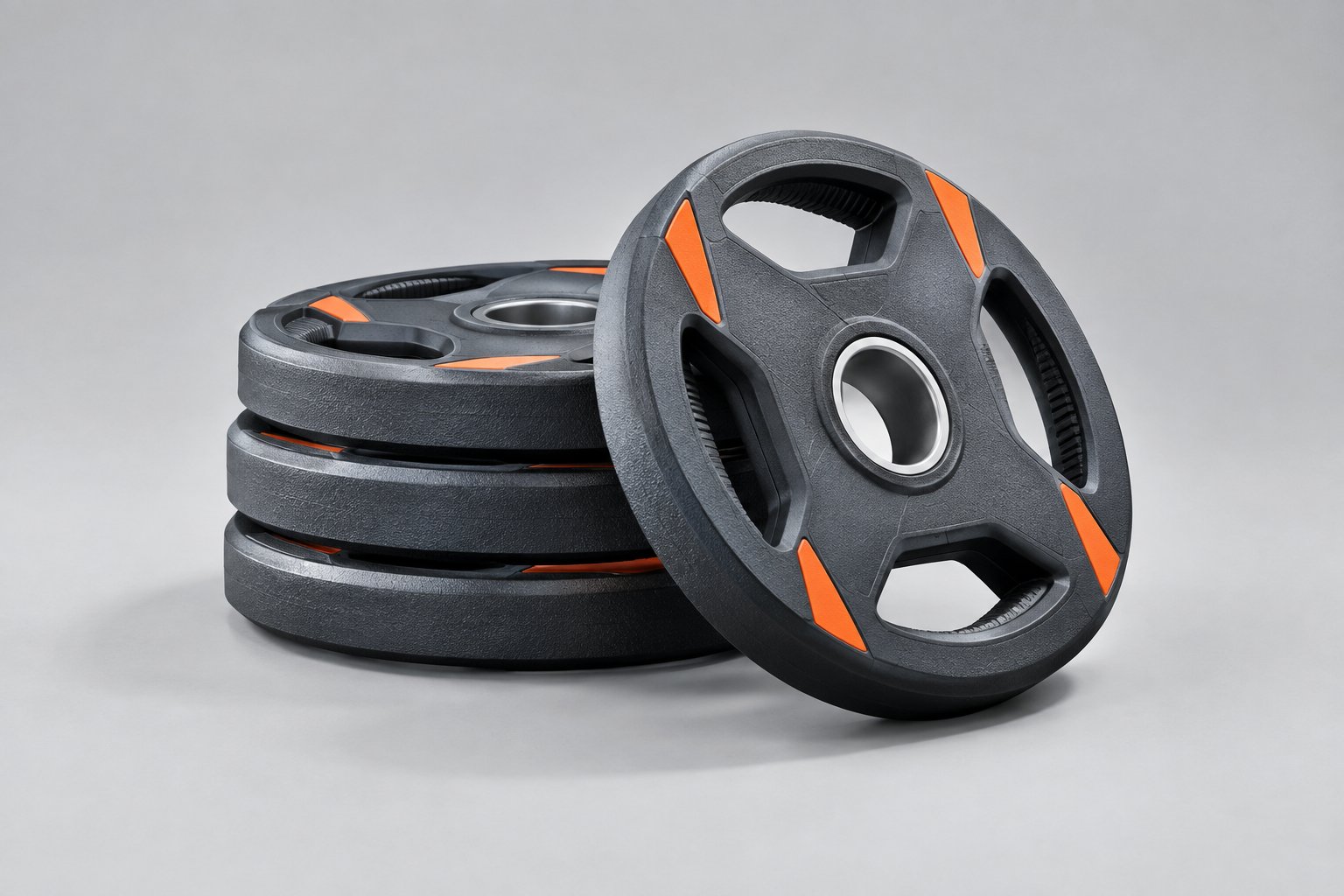
Weight plates are the volume backbone of every free-weights catalog: they attach to every rack sale, every barbell sale and every bench sale, and they are the component buyers judge most literally — by whether the number on the plate matches the number on the scale. Three decisions decide whether your plate program builds reviews or burns them: bore size, coating route, and the tolerance discipline behind the casting. Our free-weights line supplies plates in the two standard bores — 50 mm Olympic and 28 mm standard — across four coating routes, with weight error and bore tolerance sampling-inspected on every batch, because tolerance is exactly where cheap plates fail and where your reviews will say so. This article explains the two bores and what they mean commercially, compares the coating routes, sets out the tolerance questions to ask any supplier, and closes with channel matching and the freight math of shipping iron by the set.
Bore size: 50 mm Olympic versus 28 mm standard
The bore is the hole in the middle, and it is the first compatibility question because it cannot be retrofitted. The 50 mm (2-inch) bore is the Olympic standard: it fits Olympic bars with rotating sleeves, it is the size of every bumper plate, and it is the default for anyone training seriously at home or in a studio — the segment that buys racks and barbells and then keeps adding plates. The 28 mm (1-inch) bore is the standard-bar world: lighter bars, lower price points, and the entry-home buyer whose whole kit — bar, plates, maybe a bench — fits in a corner and a budget. Commercially, the 50 mm line is where lifetime customer value lives: Olympic buyers upgrade in plate increments for years, so a store that sells one 50 mm set is selling a subscription-like reorders stream. The 28 mm line wins the entry transaction and bundles well into starter kits. Our category carries both bores, and the practical rule is: match the bore to the bar you are selling beside it, and say so in the listing — bore mismatch is the single most avoidable return in this category.
The four coating routes
Plates leave the foundry as gray iron; everything the buyer touches afterward is the coating decision. Four routes cover the market:
| Route | What it is | Strengths | Watch-outs | Channel fit |
|---|---|---|---|---|
| Rubber-coated | Cast iron encased in rubber, often with chrome-plated hub ring | Quiet, floor-safe, no rust bloom, pleasant handling | Rubber odor if compound is low grade — specify low-odor stock | Home e-commerce, garage gyms |
| Painted / hammer-finish cast iron | Machined or as-cast iron with durable paint | Lowest cost, classic look, grippy edges | Paint chips; bare edges can mark floors | Value tiers, starter sets |
| Chrome-plated | Machined iron with plating | Clean aesthetic, precise feel, slim profile | Plating shows wear over years; loud on floors | Studios, aesthetic-led listings |
| Urethane-encased | Cast iron in polyurethane shell | Commercial-grade: sweat, chalk and cleaner resistant; odorless | Highest cost per kg | Commercial gyms, hotels, PT studios |
For most e-commerce catalogs the working pair is rubber-coated for the main line and painted iron for the value line; urethane earns its cost wherever equipment is used by strangers every day.
Tolerance: the discipline behind the number
The number molded or cast into a plate is a contract, and tolerance is how the industry keeps it. In our sourcing standard, weight error on plates is held to about plus-or-minus one percent at batch sampling (indicative example tolerance — your purchase contract sets the binding figure), alongside bore tolerance checks, because a plate that fits loosely on the bar rattles and wears regardless of its weight. Loose tolerance shows up in reviews with remarkable speed: buyers photograph plates on kitchen scales, and side-by-side mismatch inside a purchased pair or set is treated as fraud, not variance. The inspection questions to put in writing: what weight tolerance the foundry holds, whether plates are weighed per batch or per shipment, what bore tolerance applies to the hub, and whether painted and rubber-coated lines are checked on the same scale. A supplier who answers all four without hesitating is running a real QC loop; one who cannot is selling castings with stickers.
Color coding, bumpers and the calibrated question
Three adjacent product decisions ride along with coating. Color coding by weight is standard on competition-style plates and increasingly common on rubber-coated training plates — it photographs well, aids interval workouts, and costs little; keep the coding scheme consistent across your catalog so returning buyers can extend their sets. Bumper plates — dense rubber discs with steel inserts sized for the 50 mm bore — belong in any catalog that sells Olympic lifting or garage rigs, because they are floor-safe for drops and their uniform diameter (weight added through thickness, not width) is what bar height depends on; our barbell article pairs with them directly. True calibrated plates — the tight-tolerance competition plates certified for the platform — are a niche where gyms pay for precision; most stores should sell honest training-tolerance plates rather than claim calibration they have not tested.
Matching plate sets to channels
Sell plates the way buyers assemble them. Entry home: a 28 mm starter set — bar, a spread of small plates, collars — positioned as one SKU; the buyer's alternative is not another store, it is no purchase at all. Garage: 50 mm rubber-coated sets in pair increments, sold alongside racks and bars, where the rack sale pulls the plate sale and vice versa. Studio and commercial: urethane or quality rubber sets with tighter tolerance documentation, ordered by container with the documentation pack that commercial buyers must show their own clients. Across tiers, print the increment ladder in the listing and state the tolerance in plain words — "batch-inspected, weight error within about one percent" (adjust to your contract) — because in this category the honest number is itself a selling point.
Freight math: shipping iron by the set
Plates are the densest product in a fitness catalog, and the freight system prices that relentlessly: carriers apply handling surcharges from roughly 50 lb (about 22.7 kg) and cap parcels at 70 lb (USPS) or 150 lb (UPS/FedEx), per eFulfillment Service's July 2025 review — so light pairs parcel, full sets go LTL or pallet, and container programs are where plate economics actually live. Two practices keep the math sane. First, design sets as shippable objects: pair-labeled cartons, hub-protected inserts, and a gross weight that lands where a carrier tier changes cleanly rather than one pound past it. Second, mix containers: heavy iron paired with light, high-margin SKUs — bands, mats, accessories — turns dead cubic meters into margin, which is the consolidation approach our logistics team plans by default. For dropshipping sellers, plates are a stock-and-ship category, not a parcel-per-order category; the overseas warehouse is what makes sets deliverable in days instead of weeks.
Conclusion
Plates reward the boring decisions made precisely: right bore for the bar beside them, right coating for the channel, tolerance inspected batch by batch, sets designed for the freight tier that will actually carry them. Get those four right and plates become the reorder engine of a free-weights catalog — the SKU customers keep adding to for years. Send us your channel and target set list, and we will return bore and coating recommendations with tolerance terms, batch inspection documentation and indicative set quotes from inside the casting cluster.
Frequently asked questions
Should a store stock 50 mm or 28 mm plates? Both, by role: 50 mm Olympic-bore plates anchor the serious home, garage and studio segments and drive years of incremental reorders; 28 mm standard-bore plates win entry-home starter sets on budget bars. Match bore to the bar you sell beside it and state it clearly in the listing.
What plate weight tolerance is acceptable? Our sourcing standard samples weight error at about plus-or-minus one percent per batch with bore tolerance checks (indicative example — the purchase contract sets binding figures). Buyers photograph plates on kitchen scales, so loose tolerance converts directly into one-star reviews.
Are bumper plates worth stocking? Yes wherever you sell Olympic lifting, racks or garage rigs: they are floor-safe for drops, and their uniform diameter keeps bar height consistent across weights. They pair naturally with the Olympic barbell line.
How do sellers ship heavy plate sets economically? Light pairs parcel within carrier tiers; full sets move LTL or pallet, and container programs with mixed loads — heavy iron plus light, high-margin SKUs — are where plate economics live. Overseas-warehouse stocking makes sets deliverable in days.